第四集
Sacralisation of Ancient Graves
- 51See C. Salmon, “À propos de quelques tombes chinoises d’Indonésie,” Archipel 12 (1976), pp. 207-218 (…)
33In the late 1970s one could still see some rare remains of former cemeteries. During our successive field works we discovered eight tombs whose owners were for the most part men native to South Fujian, and in one case the Indonesian wife of a Chinese settler. 51 The oldest dates back to 1664 and the most recent to 1801. Seven were found on the north coast of Java, and the eighth in Ambon (Moluccas).
34From West to East:
35Cape located 40 km north of Tangerang famous by its Chinese temple which is the object of pilgrimages.
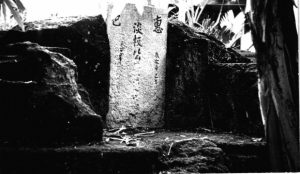
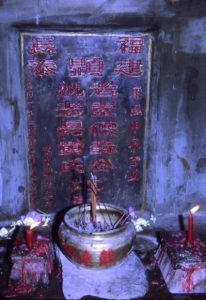
36A funerary stele of 1747 (Plate 12) located on the left side of the road leading to the temple, not far from it, in a place called Kebon Baru, which formerly was part of a Chinese cemetery. During the second half of the 18th century Tanjung Kait was a centre of sugar production (as we have seen above). It started to decline towards the end of the 18th century in relation to the sugar crisis that shook West Java. This very fact may explain why the Chinese sugarcane growers gradually moved elsewhere, leaving behind an abandoned cemetery.
Plate 12 – Sacred tomb of a Bugis lady, dated Qianlong 12 (1747), formerly part of the Chinese cemetery of Tanjung Kait
古墓的神圣化
51见C.Salmon,“印度华人的提议”,群岛12(1976),第207-218页(…)
33在20世纪70年代末,人们仍然可以看到一些罕见的前公墓遗迹。在我们连续的实地工作中,我们发现了八座坟墓,其主人大多是福建南部的男性,其中一座是一位中国定居者的印尼妻子。51最古老的可追溯到1664年,最近的可追溯到1801年。其中七个在爪哇岛的北海岸被发现,第八个在安本(Moluccas)。
34从西到东:
谭荣凯
35开普位于丹格朗以北40公里处,因其中国寺庙而闻名,是朝圣的对象。
361747年的一块墓碑(图版12),位于通往寺庙的道路左侧,离寺庙不远,位于一个名叫凯邦巴鲁的地方,以前是中国墓地的一部分。在18世纪后半叶,丹戎开特是一个制糖中心(如上所述)。18世纪末,由于席卷西爪哇的糖危机,它开始衰落。这一事实或许可以解释为什么中国甘蔗种植者逐渐转移到其他地方,留下一个废弃的墓地。
图版12——一位布吉斯夫人的圣墓,建于乾隆12年(1747年),原为丹戎开中国公墓的一部分
Photo: C. Salmon
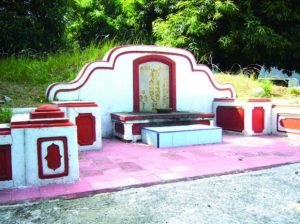
Plate 14 – Overview of the sacred grave of Chen Sancai dated 1765, Cirebon
照片:C.鲑鱼
图版14——1765年的陈三才神墓概览,井里汶
Photo: C. Salmon
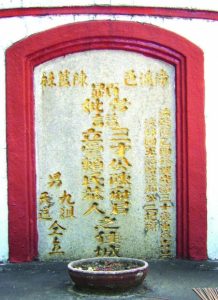
Plate 15 – Epitaph of Chen Sancai
照片:C.鲑鱼
第15版——陈三才墓志铭
38Three steles, two of them dating from 1797 (Plate 16) and the third from 1804. They are located south of the city, in a place called Gergaji, on the western side of Jalan Gajah Mada and at the foot of the Hill of Candi.
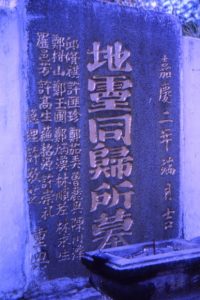
Plate 16 – Sacred collective tombstone erected after the transfer of a former cemetery in Semarang, 1797
照片:C.鲑鱼
三宝垄
383块石碑,其中两块可以追溯到1797年(图版16),第三块可以追溯到1804年。他们位于城市的南部,一个名叫格尔加吉的地方,在贾兰·加贾·马达的西侧,坎迪山的山脚下。
图版16——1797年,三宝垄一座前墓地转移后竖立的神圣集体墓碑
Ambon
39A tombstone of 1664, repaired in 1913 (Plate 17) located opposite the city across the Bay, in a place called Rumah Tiga that was easily accessed by boat.
Plate 17 – Sacred tomb said to be of “the first settler in Ambon and of his wife,” dated 1664
安本
39一块1664年的墓碑,1913年修复(图版17),位于海湾对面的城市对面,一个名叫鲁玛·蒂加的地方,船很容易到达。
图版17——据说是1664年“安本第一位定居者及其妻子”的圣墓
40An interesting fact is that at least six of these tombs became the object of genuine worship on the part of the inhabitants―newcomers, local born Chinese and even other Indonesians―who do not hesitate to spend money to maintain these historical sites nowadays regarded as sacred―kramat in Indonesian. The way in which the cult was formed is not always very clear. The only dates that could give us information about the emergence of the cult are the restorations of monuments: 1904 and 1923 for the tomb of Tumenggung Chen Sancai in Cirebon, 1932 for the tomb of Ambon. One would think that these cults are not very old; they probably appeared at a time when the old burials were beginning to be rare and when ancient cemeteries were disappearing gradually. The contact with the ancestors then crystallized on a few privileged graves in front of which the fervent worshippers questioned the oracle with the use of beijao 杯珓 or “divination blocks.”
- 53 the excellent study by Seiichi Iwao, “On the Chinese Quarter at Amboyna in the Early Ming,” in (…)
- 54Wang Dahai 王大海 in his travelogue used the same transcription; cf. Haidao yizhi 海岛逸志, ed. Yao Nan 姚楠 (…)
41At Ambon, the encountered devotees told us that it was the grave “of the first Chinese to settle in the island and of his wife”, but in fact the implantation of the Chinese goes back to the Ming. 53 The first Chinese captain appointed by the Dutch in 1625 at Ambon was a Christian named Herman. In Tanjung Kait, the cult took a native form; the tomb bears the name of Kramat Embah Dato Kebon Baru or “Holy Tomb of the Grandmother of Kebon Baru.” There is in effect a set of three large tombs, and two small ones, all considered as kramat and visited by pilgrims who come to spend the night nearby and ask the deceased’s help. Sticks of incense and an oil lamp are burning continuously before the graves. Only the largest preserves its stele, which shows that the tomb owner is a woman, presumably a Bugis (transcribed in Hokkien as Bu-git 武吃)54 whose husband’s surname is Lu 卢 (Plate 12). In Cirebon, the cult rendered to Chen Sancai by the Sino-Indonesians of the place is explained, according to the inscription of 1923, by the fact that during his lifetime this great character had done much to aid his compatriots. The effectiveness of Chen Sancai seems to have affected the neighboring tomb dated 1702 which belongs to a certain Chen Kuanguan 陈宽官. As the two deceased bear the same surname and are native to the same district, the story goes that it is the tomb of the father of Chan Sancai, which is likely.
- 55Liem Thian Joe [林天佑], Riwajat Bangsa Tionghoa di Indonesia. Riwajat Semarang, Semarang: Kamadjoean, (…)
42In Semarang the worship of the two tombs appeared in a different way. When in 1797 (as we saw above) the rather dilapidated tombs of the former cemetery had to be transferred outside of the city, Captain Tan Yok Sing 陈煜生 entrusted the matter to his assistants who asked a master in geomancy to find a suitable location, and the bones contained in jars were placed into two mass graves on which was erected a stele each. The first bearing the characters Diling tonggui suomu 地灵同归所墓 “Collective tomb located in an efficacious place” (Plate 16), and the second, a commemorative inscription entitled Yingxiu tonggui 营修同归 “Construction of a place where [the deceased] return together,” which briefly retells the transfer process.55
- 56Liem Thian Joe, Riwajat Bangsa Tionghoa di Indonesia, pp. 60-61. The inscription is still in situ.
43At the same time, to protect the population from the evil influence of the dead who had been disturbed, a stone bearing the invocation “Namaḥ Amitâbha [Honor to the Amitabha Buddha] 南无阿弥陀佛 [Auspicious Peace] ji’an 吉安” was fixed into the wall of a house in Jalan Petolongan close to the location of the displaced tombs, by fear of the unsettled spirits.56 After Captain Tan Yok Sing passed away in 1800, his eldest son, Tan Liong Djoe 陈隆裕, replaced him as head of the community. Having seemingly a great compassion for the dead whose remains had been disturbed, he appealed to all notables, including the captains of Pekalongan and Tegal, to whom he was probably related since they share the same surname. In 1804 he erected a building intended for the cult of the dead (since destroyed). The event was commemorated by a third stele that could still be seen lying on the ground next to the mass graves.
44The introductory text shows the affliction of the captain and his desire to worship the deceased:
40一个有趣的事实是,这些陵墓中至少有六座成为当地居民——新来者、当地出生的华人,甚至其他印尼人——真正崇拜的对象,他们毫不犹豫地花钱维护这些如今被视为神圣的历史遗址——印尼的克拉马特。邪教的形成方式并不总是很清楚。唯一能给我们提供有关这一邪教出现的信息的日期是对纪念碑的修复:1904年和1923年,慈里汶的图们贡陈三才墓,1932年,安本墓。人们会认为这些邪教并不古老;它们可能出现在古墓葬开始稀少、古墓地逐渐消失的时候。随后,与祖先的接触在几座享有特权的坟墓上具体化了。在这些坟墓前,狂热的朝拜者们用“北疆”来质疑神谕杯珓 或“占卜块”
53参见岩尾诚一(Seiichi Iwao)的优秀研究《明初安博伊纳(Amboyna)的中国区》,在(…)
54王大海王大海 在他的游记中使用了同样的抄本;比照海道益智海岛逸志, 姚楠姚楠 (…)
41在安邦,遇到的奉献者告诉我们,这是“第一个在岛上定居的中国人及其妻子的坟墓”,但事实上,中国人的植入可以追溯到明朝。53 1625年荷兰人在安邦任命的第一位中国船长是一位名叫赫尔曼的基督徒。在Tanjung Kait,邪教采取了本土形式;这座陵墓的名字是克拉马特·埃巴·达托·凯邦·巴鲁或“凯邦·巴鲁祖母的圣墓”实际上,这里有一套三座大坟墓和两座小坟墓,都被认为是克拉马特,朝圣者前来附近过夜,寻求死者的帮助。香烛和油灯在坟墓前不停地燃烧着。只有最大的一座保留了它的石碑,这表明墓主是一名女性,大概是一名布吉斯人(在福建省抄写为Bu git)武吃)54谁的丈夫姓卢卢 (图12)。在井里汶,根据1923年的碑文,当地的华裔印尼人对陈三才的崇拜可以解释为,这位伟大的人物在他有生之年为他的同胞做了很多帮助。陈三才的效力似乎影响了附近1702年的陈宽宽墓陈宽官. 由于两位死者姓氏相同,并且出生在同一个地区,所以传说这是陈三才的父亲的坟墓,这很有可能。
55 Liem Thian Joe[林天佑], 印度尼西亚的Riwajat Bangsa Tinghoa。Riwajat三宝垄,三宝垄:Kamajoean,(…)
42在三宝垄,对两座坟墓的崇拜以不同的方式出现。1797年(正如我们在上面看到的),前公墓相当破旧的坟墓不得不转移到城外,陈玉成上尉陈煜生 将此事委托给他的助手,后者要求一位风水大师找到一个合适的位置,罐子里的骨头被放进两座乱葬坑,每个乱葬坑上都竖起了一块石碑。第一个字是帝陵通贵索姆地灵同归所墓 “集体陵墓位于灵验之地”(图版16),第二个是题为“映秀同贵”的纪念铭文营修同归 “建造一个(死者)一起返回的地方”,简要地重述了转移过程。55
56 Liem Thian Joe,印度尼西亚Riwajat Bangsa Tinghoa,第60-61页。碑文仍在原处。
43同时,为了保护民众免受被扰乱的死者的邪恶影响,一块刻着“纳玛”字样的石头ḥ 阿弥陀佛[向阿弥陀佛致敬]南无阿弥陀佛 【祥和】吉安吉安” 由于害怕不安定的灵魂,它被固定在贾兰佩托洛根一座房屋的墙上,靠近被转移的坟墓。56 1800年,船长陈玉成去世后,他的长子陈良哲(Tan Liong Djoe)去世陈隆裕, 取代他成为社区负责人。他似乎非常同情那些遗骸被打乱的死者,因此呼吁所有知名人士,包括佩卡隆安和特加尔的船长,他可能与他们有亲戚关系,因为他们同姓。1804年,他修建了一座用于祭拜死者的建筑(自被摧毁以来)。为了纪念这一事件,人们还可以看到第三块石碑躺在万人坑旁边的地上。
44介绍性文字显示了船长的痛苦和他崇拜死者的愿望:
- 57See Salmon, “À propos de quelques tombes chinoises d’Indonésie,” pp. 214-218; Franke, Salmon & Siu (…)
It is distressing to attend a funeral, but to worship the dead is even more distressing. In order to perpetuate the sacrifices, we erected a building of four intercolumnations [dedicated to the souls of the dead]. The faithful, according to their means, secretely make donations that are transmitted to the Nine Sources. Each year, during the Feast of the 3rd day of the 3rd month, all together we offer a banquet. Everyone approved this, and we did erect a stele so that these facts do not fall into oblivion.57
序曰:埋固艰,祭更艰,欲垂祀事於千古,爰建缘屋之四间,同归灵感,士人向前
丰约,随其善愿,阴隲施及九泉。每届上巳,共钦奠筵。佥曰: 然然勒碑不湮。
- 58Liem Thian Joe, Riwajat Bangsa Tionghoa di Indonesia, 58. The two tombstones are still in situ.
45We ignore what happened after Captain Tan Liong Djoe passed away in 1811. However, according to Liem Thian Joe, in the early 1930s the Chinese population of Semarang still used to burn incense at the graves and seek advice from the deceased when they participated in games of chance,58 and in the 1990s freshly consumed incense sticks could still often be seen in front of the tombs.
46The examples presented above show enough that the owners of the graves may be a menace for the living, but also a source of power which may be manipulated. They are also a link between the first settlers whose history is often forgotten and the present communities; this very fact explains why some graves may become the centre of ritual activity emanating from people who are not related to their owners.
Control and Management of Burial Grounds
47We intend to end this essay by reflecting on the way burial grounds were granted in concession by the political authorities, either local or colonial, the manner the Chinese community leaders administrated cemeteries, and made profits from them.
48To the best of our knowledge no written sources concerning the cemeteries of the sultanates of Banten and Cirebon have surfaced so far. From what has been said above, one may infer that, as regards Banten, the Chinese based in Kelapadua were rather free to bury their dead within the compound which was at their disposal. It seems that their counterparts residing in town did not enjoy such a free scope. The superficies allotted to burial grounds in Kasunyatan and the Western Pecinan give the impression that either for financial or political reasons the land for cemeteries was given sparingly.
49As for Cirebon, the situation seems to have been rather different. If we judge from the huge superficies of the kramat of Chen Sancai, and the space occupied by the two tombs of 1701, which are now all in the heart of the city, one may assume that land for cemeteries was granted more generously.
- 59Plakaatboek, vol. I, pp. 454-455, 2 Dec.- 2 Feb. 1641.
- 60Plakaatboek, vol. II, pp. 335-336, 11 June 1660.
50In Batavia the Dutch tried to control Chinese funerary practices and limit the spaces occupied by public cemeteries within the city by implementing a series of taxes and by setting fines to offenders, the amounts of which were supposed to be used for the maintenance of the Chinese Hospital (founded in 1640). For the period 1602-1811, the Plakaatboek records a series of rules. A tax on funerals (graff gelt), graduated according to the quality of the deceased, was first issued in 1641.59 Nineteen years later its amount was increased from 2 to 3 rixdollars; while a new tax was added for the engraving of an epitaph which amounted to 12 rixdollars.60
- 61Plakaatboek, vol. X, p. 174, 31 Dec. 1778.
- 62James Cook, A Journal of a Voyage round the World in the “Endeavour,” 1771, published in Hawkeswort (…)
- 63Plakaatboek, vol. XI, pp. 283-284, 9 August 1791. For more details, see C. Salmon & Myra Sidharta, (…)
51Further rules were added which concerned the size of the tombs: “It was decided so because it is the habit of this nation to bury only one body in each tomb, which has the consequence of very quickly filling the cemeteries.”61 James Cook who was in Batavia ca. 1771 also insists on this singular use which results in the fact that the Chinese cemeteries around Batavia occupy huge superficies and he says that it is the reason why the Dutch are angry to see such a waste, and sell burial lands to the Chinese at the most exorbitant prices.62 In 1791 the VOC added a new rule concerning the size of the tombs of the heads of the Chinese. Henceforth their graves shall not exceed a width of 24 feet, a length of 36 and a maximum height of 8 feet, with the possibility to raise the latter to 10 and 11 feet, provided that the earth necessary to this extra height is not taken from the cemetery. As for the tombs of other members of this nation, they should be limited to a width of 8 feet, a length of 12 and a height of 6. The captain is requested to ensure that no one transgresses these new limitations under penalty of a fine of 500 rixdollars.63
第214-218页;法兰克、三文鱼和烤肉(…)
参加葬礼是痛苦的,但崇拜死者更痛苦。为了使祭品永久化,我们建造了一座由四个柱间建筑组成的建筑[献给死者的灵魂]。信徒们,根据他们的手段,秘密地进行捐赠,并将其传递给九个来源。每年,在第三个月的第三天的宴会期间,我们一起举办宴会。每个人都同意这一点,我们确实竖起了一块石碑,这样这些事实就不会被遗忘。57
序曰:埋固艰,祭更艰,欲垂祀事於千古,爰建缘屋之四间,同归灵感,士人向前
丰约,随其善愿,阴隲施及九泉。每届上巳,共钦奠筵。佥曰: 然然勒碑不湮。
58 Liem Thian Joe,Riwajat Bangsa Tinghoa di Indonesia,第58页。这两座墓碑仍在原处。
45我们忽略了1811年陈良哲船长去世后发生的事情。然而,根据Liem Thian Joe的说法,在20世纪30年代早期,三宝垄的中国人仍然在坟墓前烧香,并在参加“机会游戏”时向死者寻求建议,58在20世纪90年代,人们仍然可以经常看到墓前新消费的香。
46上述例子充分表明,坟墓主人可能是生者的威胁,但也是可能被操纵的权力来源。它们也是第一批定居者和现在社区之间的纽带,他们的历史往往被遗忘;这一事实解释了为什么一些坟墓可能成为与主人没有亲属关系的人的仪式活动中心。
墓地的控制和管理
47.在结束本文之前,我们打算回顾一下当地或殖民地的政治当局特许授予墓地的方式,以及华人社区领袖管理墓地并从中获利的方式。
48据我们所知,到目前为止,还没有关于万丹和井里汶苏丹国墓地的书面资料。从上面所说的,我们可以推断,关于万丹,总部设在克拉帕杜阿的中国人相当自由地将死者埋葬在他们可以支配的大院内。似乎居住在城里的同行们并没有享受到这样的自由空间。Kasunyatan和西Pecinan的墓地的地上权给人的印象是,无论是出于经济还是政治原因,墓地的土地都得到了节约。
49至于井里汶,情况似乎大不相同。如果我们从陈三才墓穴的巨大表面,以及1701年的两座陵墓所占的空间来判断,这两座陵墓现在都位于城市的中心地带,人们可能会认为墓地的土地被更慷慨地授予。
59 Plakaatboek,第一卷,第454-455页,1641年12月2日至2月2日。
60 Plakaatboek,第二卷,335-336页,1660年6月11日。
50在巴达维亚,荷兰人试图控制中国的葬礼习俗,并通过实施一系列税收和对违规者处以罚款来限制城市内公共墓地占用的空间,罚款金额本应用于维护中国医院(建于1640年)。在1602-1811年间,普拉卡图博记录了一系列规则。葬礼税(graff gelt)于1641年首次颁布,根据死者的质量分级。59 19年后,其金额从2里拉增加到3里拉;而墓志铭的雕刻又增加了一项新税,总计12里克斯币。60
61 Plakaatboek,第十卷,第174页,1778年12月31日。
62詹姆斯·库克,1771年《奋进号》中的一本环球航行杂志,发表在《霍克斯沃特》上(…)
63普拉卡特博克席,第十一卷,第28至第28页,1791年8月9日。有关更多详细信息,请参见C.Salmon&Myra Sidharta,(…)
51关于坟墓的大小,又增加了一些规定:“之所以决定这样做,是因为这个国家的习惯是每个坟墓只埋葬一具尸体,这会导致墓地很快被填满。”61 1771年在巴达维亚的詹姆斯·库克(James Cook)也坚持这种独特的用途,这导致巴达维亚周围的华人墓地占据了巨大的土地面积,他说这就是为什么荷兰人看到这样的浪费感到愤怒,并以最高昂的价格将墓地卖给中国人的原因。62 1791年,VOC增加了一项关于中国人头像坟墓大小的新规定。从今以后,他们的坟墓不得超过24英尺宽,36英尺长,最大高度不得超过8英尺,并有可能将后者提高到10英尺和11英尺,但前提是不从墓地获取达到这一额外高度所需的土壤。至于这个国家其他成员的坟墓,它们的宽度应限制为8英尺,长度为12英尺,高度为6英尺。船长被要求确保没有人违反这些新的限制,并被处以500里拉的罚款。63