

ARCHAEOLOGICAL DISCOVERY OF THE LATE 17TH CENTURY TEA REVOLUTION CALLED GONG FU TEA
There is a great debate on the question of whether Gong Fu Tea existed in history.
Eminent Professor Jean DeBernardi of the University of Alberta, Canada, who was funded by the Chiang Ching-kuo Foundation of Taiwan and the University of Alberta, did research on Gong Fu tea.
She came out with findings which claimed that Gong Fu tea was a recent Taiwanese invention, influenced by contacts with Japan.
On the other hand, Professor Yan Li-Ren and his team of academics from Xiamen University have disagreed with Dr. DeBernardi’s research findings.
They contend that Gong Fu tea started in the 17th century and that it originated from Zhangzhou, in Fujian, China.
Other tea experts, however, have disputed this, claiming that Gong Fu tea was an old Chaozhou invention passed down to the modern day.
Professor DeBernardi was correct to doubt the existence of Gong Fu Tea in history because there is no documented proof.
The only archaeological evidence is in the form of an excavated small Ming Yuan Yixing teapot with four Roushen teacups (small porcelain cups, first created by a potter called Roushen during the Kangxi period) and a dish found in Lan Gao Wei’s grave. The epitaph dated ‘23rd Year Reign of Emperor Qian Long ‘(AD 1726) in Qianyuan Village, Chiling Town, ZhangPu County, Fujian, China (see pg 82 Appreciation of Zisha Teapots by Nanjing Museum), however, does not prove or is not proof enough that Gong Fu tea existed in history.
But things changed when the Ren Fu Collection appeared on the scene and surprised the world with its huge archaeological trove of excavated Gong Fu tea ware.
THE MYSTERIOUS TRINITY AND THE MENG CHEN PHENOMENON
We did not set out to find Hui Meng Chen, or the legendary small Meng Chen Zhuni Pot or even the origins of Gong Fu tea because we did not start out as a research outfit in the beginning.
We were a rescue team specialising in salvaging cultural artefacts from old Chinese burial sites facing demolition due to residential, commercial and industrial developments in the Nanyang countries (South-east Asia) from the 1970s to the 1990s.
During the excavations, we found that almost all our unearthed cultural relics were teapots and other tea ware. We did not have an idea what they really were, so we embarked on a fact-finding mission.
We went to Hong Kong, Taiwan, mainland China and the Nanyang region where there are sizable Chinese tea drinking and tea art communities to get some idea of the subjects we might be dealing with, particularly the tea culture that our excavated artefacts, comprising almost all tea wares, might possibly be part of.
We consulted with the most knowledgeable sources and read up books but after a few years of fact finding we came away puzzled by three mysteries, which at that time we did not have a clue that they were interconnected.
Everywhere in the Chinese tea drinking communities, the name Hui Meng Chen is always mentioned and it can be found on most sea-salvaged, unearthed or collected Yixing teapots, including those highlighted in books, auctions and museums.
And it seemed that as a symbol of Chinese tea culture greatness, real Gong Fu tea must involve the use of a small Meng Chen Zhuni pot. We found that there was constant mention of the name Meng Chen everywhere, including in most of our rescue-excavated pots with recorded archaeological details.(Fig.1, 2)
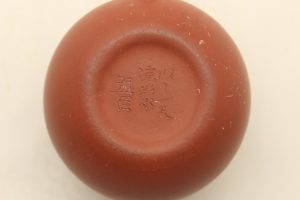
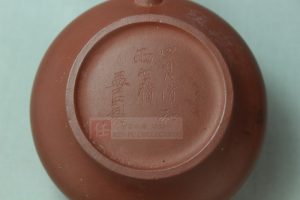
Fig.1, Fig.2
But there was a catch to all these: Where was the proof to show when Hui Meng Chen lived, when did he make his legendary teapots or even the question as to when Gong Fu tea began?
These recurrent questions compelled us to refer to the matter as the “mysterious trinity”.
And the answers? Little do we know we were sitting on them all the while – in our more than thousand excavated teapots, most of which had Meng Chen’s name inscribed on them and the fact that most of these pots were part of Gong Fu tea ware.
Before going further, let us look at the significance of the Zhuni teapots. It appeared that the Zhuni pots were the most important, in pre-Daoguang Gong Fu tea ware.
WHAT IS ZHUNI CLAY AND WHAT IS SO SPECIAL ABOUT THE SMALL MENG CHEN ZHUNI POT?
The world of Yixing tea ware is full of myths, misconceptions, exaggerations, hype and involves the most forgeries in the art world.
As such, it can be quite challenging for someone new to Yixing tea ware to understand the Yixing clays used for making Yixing teapots. And of all Yixing clays, perhaps the most confounding is Zhuni, the famous orange-red clay.
While searching for information online, one can find confusing references of “old Zhuni” versus “modern Zhuni”, of Zhuni being “extinct “, and the claim that “modern Zhuni” is in fact “Hongni” or a mixture of Hongni and other Yixing clay.
Whatever the conflicting claims, Hongni and Zhuni are simply two different kinds of ores, with different mineral compositions.
While Hongni is an argillaceous siltstone, a sedimentary rock formed with silt-sized particles, Zhuni is a mudstone which has been concreted within other sedimentary rocks with mud-sized particles (finer than silt). The raw ores look quite different, though both become reddish when fired.
While all Yixing ores shrink upon firing, the different compositions of Hongni and Zhuni ores result in a significant difference in shrinkage. On average, Hongni shrinks around 15% of its unfired size, whereas Zhuni shrinks between 17% to 25%.
In addition to a fine particle size, this means that the fired Zhuni will be noticeably denser as well, heavier for its size and with a smoother surface in contrast to Hongni’s sandier surface. Some people even claim that Zhuni teapots have a silky feel and a jade-like look.
Although there are many regions in China where clay deposits are found, Yixing is the only area with ore that is suitable for making teapots. Also, Purple-Sand ore is not found everywhere in Yixing.
The strata from where the ore is mined, is only found several hundred metres below sea level. Such deep mining is dangerous and if it was not for the high demand for Zisha pots especially Zhuni pots, mining would not have been worthwhile and Chinese tea culture would have developed along different lines.
Zhuni is the rarest clay and has the highest iron content and the lowest success rate after firing due to its high shrinkage. Zhuni pots, especially antique ones, are the most expensive and sought after by collectors and certain tea drinkers.
In the long history of tea drinking, the design of tea wares evolved to define the tea drinking experience. The quest for the highest quality tea and the highest compatibility between tea and tea utensils can only be found in the culture of Gong Fu tea.
The perfect or quintessential Gong Fu tea is one made with a small Meng Chen Zhuni Pot and drank in Roushen teacups, just as the founding Gong Fu tea masters of the early Qing era had in mind, as the criteria for the best Gong Fu tea.
According to tea art experts, the test of a potter’s skill lies in the pot’s functionality and beauty. The spout must pour without dribbling, the handle must have a good grip and feel right in one’s hand and above all, the lid must have a good fit. The art lies in achieving a harmonious equilibrium of all the requirements mentioned.
A performance test on Ren Fu Collection’s Pot No: 387 (Fig.3 and 4)for which we have archaeological proof that it is one of the legendary small Zhuni Pots that Hui Meng Chen made during Shunzhi’s reign (1644-1662), showed that it passed the test without any doubts and more. We found the small Meng Chen Zhuni pot makes the freshest, the best aroma, the best colour and most importantly, the quickest tea which indicated a kind of breakthrough, by Hui Meng Chen, in Yixing teapot design and Yixing clay technology at that time. Hui Meng Chen’s aim was to produce a teapot best suited to the rigors of life during the civil wars of the late Transition Period(1620-1683) especially in Fujian, the last bastion of NanMing forces on mainland China to fall to the advancing Qing army. A life where speed, alertness and clarity of mind were essential to human survival.
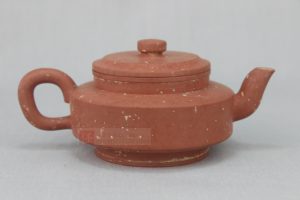
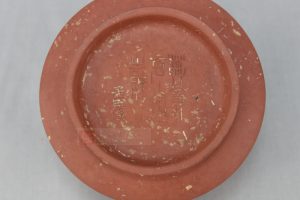
Fig.3 and 4
In addition, we also found in our archaeological trove that one of the reasons why the small Meng Chen Zhuni pot is legendary, was its versatility in times of peace as well as war.
During the frantic civil wars the small Meng Chen Zhuni pot or any other small Zhuni pot for that matter, could be used on its own – for brewing and drinking tea directly, without teacups – or as part of indoor or outdoor Gong Fu tea, or it could be part of a mobile portable traveling tea kit comprising the small teapot, small teacups, small dish ( tea boat), small burner (stove) and small water boiler (kettle) for making and drinking tea on the road(which the usual big late Ming Zisha pot cannot do).
N.B.The volume of our small Meng Chen Zhuni pot no:387 is 100ml and compare that to our late Ming Zisha pot no:360 which is 750ml.
REN FU COLLECTION’S 1,190 RESCUE-EXCAVATED POTS WITH RECORDED ARCHAEOLOGICAL DETAILS
Ren Fu Collection started off as a rescue unit with higher concern for future study and research. Even though we were untrained and unprofessional, our great experience and knowledge in excavating a few thousand graves and tombs helped us gain knowledge about the past .
We have this knowledge in the form of archaeological details which we have stored, including a huge quantity of data and exact-dates of unearthed artefacts.
We hope that the buried remains, unearthed during excavations and other physical remains of past human activities that we have accumulated, would help archaeologists and historical experts better analyse and reconstruct the past.
Our 1,190 pots, except for two, are all pre-Daoguang. They consist of 705 Zisha pots and 485 Santoh Zhuni pots and other tea ware like teacups, dishes, burners and water boilers . While none of our Late Ming to Shunzhi Zisha pots are Gong Fu tea ware, most of the items from the early Kangxi to Daoguang period are Gong Fu tea ware.(Fig.5)
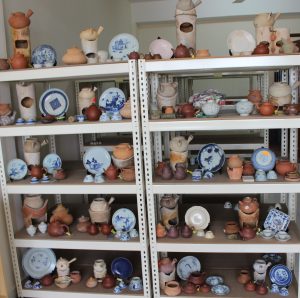
Fig.5
Out of our 705 Zisha pots, 345 or about 49% are Meng Chen Zhuni pots and almost all Meng Chen Zhuni pots are part of Gong Fu tea ware.
Although most of our excavated items are Gong Fu tea ware but sometimes among them were other non-Gong Fu tea articles, including jade ornaments, coins of different national origins, opium pipes, tea caddies, official Qing headwear, and even the occasional human bones.
The human remains are vital for future DNA testing to ascertain for example, to name one, the authenticity of blood relationship to the legendary historical figure Zheng Cheng Gong or Koxinga (1624-1662).
As for the estimates of the number of old Meng Chen pots produced, it is claimed by experts and proven by facts, that there are thousands of them, whether unearthed, sea-salvaged or in museums, and from old Chinese burial sites that were destroyed in great numbers by bulldozers to make way for modern developments. Many are still believed to be in the hulls of sunken ships or buried inside graves.
Finally, please note that our focus, in the interest of this research, is on the excavated tea ware of the Transition Period (1620 to 1683) where the revolution in Chinese tea culture occurred, amidst the chaos and turmoil.
As Soame Jenyns, the curator of the British Museum wrote in his work findings in 1955: “The period of transition between the fall of the Ming dynasty, and the rise of the Qing dynasty, as I shall define it, runs from the death of the 14th Ming Emperor Wanli in 1620, to the appointment of Zhang Ying Xuan as director of the Imperial porcelain factory at Jingdezhen, in the 21st year of Kangxi, second Emperor of the Qing dynasty, in 1683. In these 63 unsettled years, we know very little of what took place at Jingdezhen, its history overshadowed by the dynastic struggle in which the Ming dynasty went down and the travail which surrounded the birth-pangs of the Qing dynasty which succeeded it.”
Note also that during the Transition Period, not only the kiln sites in Jingdezhen, the porcelain capital of the world, in Jiangxi province were affected by civil wars but also others like Yixing, the pottery capital of China, in Jiangsu.
A BRIEF STORY ON THE DEVELOPMENT OF CHINESE TEA CULTURE
People in China knew how to grow the best tea plants before Lu Yu’s time during the Tang Dynasty. During the Tang and Song dynasties they knew how to make cakes or bricks from the best tea leaves and grind them into powder to make tea. As their knowledge grew and improved, so too did their art and techniques of making and drinking tea.
This evolution or changes in tea making and tea drinking can be observed from the Tang Dynasty when powdered tea was boiled, infused with herbs and poured into a bowl to be drunk from. In the Song Dynasty hot water was poured into a bowl of powdered tea, whisked and then drunk.
In the Ming dynasty, a revolution in tea history took place. The production of caked tea was forbidden by a royal decree and instead of powdered tea, leaves were added to boiled water and steeped, which is similar to the way we make tea today.
The first Ming Emperor being a former monk and the son of poor parents decreed that even commoners should be able to enjoy tea culture, making tea an egalitarian pursuit not only of the elite and privileged but also of the common folk.
Tea making and drinking utensils also developed into different types – from the usual chawan (tea bowl) of the Tang and Song dynasties to the gaiwan (lidded bowl) which was invented in the Ming dynasty.
The Zisha pot was invented in the late Ming dynasty and finally the revolutionary small Zhuni pot invented by Hui Meng Chen during Shunzhi’s reign. Hui Meng Chen saw a different way of making a Zisha pot smaller and more refined by using the new Zhuni clay and the creation came to be known as the small Meng Chen Zhuni pot.
With this style, tea leaves were brewed in a small pot, resulting in the ratio of tea leaves to water becoming higher, thus making the tea richer, fresher, stronger, more fragrant and more importantly, access to a quicker brew in the hurrying times of civil war.
This sparked off a revolution in tea drinking, called ‘Gong Fu tea’ during the early Kangxi era, in which the finest of tea wares and tea leaves were used to make the best tea. The five tea ware of Gong Fu tea were a small Zhuni pot, teacups, dish, water boiler and stove.
The very prosperous early Qing period not only saw greater and more affordable access to Zhuni pots than ever before but also greater production of Zhuni pots, mostly small Meng Chen Zhuni pots, which, according to our archaeological discoveries, peaked during Qian Long’s reign, thus making Gong Fu tea an affordable pastime to be enjoyed by all – aristocrats, literati as well as the common people.
This revolution did not escape the attention of other regions in the world, like Europe. Yixing teapots and tea ware like the beautiful ceramic teacups and saucers were coveted and highly prized in Europe in the 18th century, so much so that only the royalty and aristocrats could afford to own them. This was most evident during the peak of Chinoiserie craze in Europe during Qian Long’s reign.
CHA DAO: THE WAY OF TEA OR ENLIGHTENMENT THROUGH TEA
When most practitioners think about tea culture, they think about the word “Cha Dao” (茶道). More specifically, when they think of tea culture pertaining to particular countries, they think of Chinese “tea art”, the Korean “tea ceremony” and the Japanese “Chado”.
Both the Chinese and Japanese consider Lu Yu from the Tang Dynasty to be the saint of tea and originator of Cha Dao whereas the Korean considers Shen Nong as the sage of tea.
However, the word “Cha Dao” never appeared in Lu Yu’s book, The Classics of Tea (茶经). It only stated that tea is suitable for people who excel in moral behaviours and virtues (精行俭德). Some people consider Lu Yu’s “精行俭德” to be the main part of Cha Dao.
The first mention of Cha Dao appeared in a poem written by the monk Jiaoran, a famous tea expert, poet and Lu Yu’s best friend. It is said that drinking the first cup of tea caused Jiaoran to awaken from worldly illusions; the second cleansed his spirit like the earth is cleansed by a spring rain; and the third cup led to enlightenment, obviating the need to consider freedom from pain and difficulties. (一饮涤昏寐,情思朗爽满天地;再饮清我神,忽如飞雨洒清尘;三饮变得道,何须苦心破烦恼). This was the first mention of Cha Dao, which means enlightenment through tea.
We have many excavated Early Qing Gong Fu tea ware with Cha Dao poems like on Zhuni pots, teacups, dishes and burners which indicated that Gong Fu tea was as much a tea art as it was a Cha Dao and both reached their height in the Early Qing period especially in Qian Long’s reign.
POLITICS AND WARS AMIDST THE TEA CULTURE REVOLUTION CALLED GONG FU TEA
The purpose of shedding more light on the Shunzhi to early Kangxi period is for three reasons. The first is to help in the search of Hui Meng Chen’s legendary small Zhuni pot while the second is to help in the search for the origin of Gong Fu tea and the people who invented it. The third reason is to find out why Zhuni pots were not made in Yixing and where they were made instead.
Whether politics and wars in Shunzhi/Early Kangxi shaped the development of Hui Meng Chen’s small Zhuni pot and influenced the birth of Gong Fu tea are matters for conjecture but Ren Fu Collection has strong archaeological evidence to show that indeed was the case.
The Qing Dynasty was the last dynasty in the imperial history of China. It was established in 1636 in Manchuria (modern-day North-east China). By 1644 its rule extended into China proper and lasted until 1912. The Qing Dynasty was preceded by the Ming Dynasty and succeeded by the Republic of China.
In the sixteenth century, Nurhaci, leader of the House of Aisin-Gioro, began organising “banners” which were military-social units that included Manchu, Han and Mongol elements. Nurhaci united clans to create a Manchu ethnic identity and officially proclaimed the Later Jin Dynasty in 1616.
His son Hong Taiji declared the Qing Dynasty in 1636. As Ming Dynasty control disintegrated due to corruption and infightings, peasant rebels led by Ming general Li Zi Cheng conquered Beijing in 1644 but the Ming general Wu San Gui opened the Shanghai Pass (山海關) to the armies of the regent Prince Dorgon, who defeated the rebels, seized the capital, and took over the government.
Resistance from the Ming loyalists in the South and the revolt of the Three Feudatories delayed the complete conquest until 1683. (Our particular interest is the surrender of Fujian and Taiwan at the end).
The following is a brief timeline of the Qing Dynasty from the start until the early Kangxi period.
- Nurhaci created the Banner Army comprising Manchus, Hans and Mongols in 1600.
- Nurhaci died on 30th September1626
- Hong Taiji elected Khan in early 1627.
- Hong Taiji united all the Jurchen tribes under the name of Manchu, ending the Jurchens.
- Hong Taiji proclaimed the Qing Dynasty in April1636.
- The Qing Dynasty conquered Shandong in 1638.
- North-eastern China submitted to the Qing Dynasty in 1643.
- At the Battle of Shanghai Pass on 27th May1644, Wu San Gui let the Qing forces through the Great Wall and their forces defeated Li Zi Cheng in battle, after which Li Zi Cheng fled to Beijing.
- Qing forces took Beijing and Li Zi Cheng fled on the 5th June
- In 1644, large parts of South and West China were given as fiefs to three Ming generals who aided the Qing. The three feudatories were controlled by Wu San Gui, Geng Jing Zhong and Shang Zhi Xin.
- Qing forces captured Luoyang in January 1645; Yangzhou on 20th May1645; Nanjing and Hongguang Emperor on 16th June1645 and Hangzhou on 6th July
- Qing forces captured Yanping on 30th September1646, the Longwu Emperor was killed by Qing forces on the 6th October 1646 and Qing forces took Fuzhou.
- Qing forces captured Guangzhou and the Shaowu Emperor on 20th January1647, conquered Guangdong, half of Guangxi and Hainan on 5th March 1647, took Changsha on March 1647 and took Wugang on 23rd September
- Qing forces took Nanchang on 1st March1649, slaughtered the population of Guangzhou on 24th November 1649, captured Guilin on 27th November 1649, captured Zhaoqing and the Yongli Emperor fled on 2nd December 1649.
- Qing forces captured Zhoushan and Zhu Yi Hai fled on 15th October
- Qing forces captured Yongchang and Yunnan on 10th March
- Zheng Cheng Gong took Zhenjiang on the 10th of August1659 and laid siege to Nanjing on the 24th of August 1659 but Zheng Cheng Gong’s army was annihilated and he retreated to Xiamen on the 9th of September
- Zheng Cheng Gong attacked the Dutch colonists in Taiwan in 1661 and set up the Kingdom of Tungning (modern-day Tainan).
- The Yongli Emperor was captured and executed in Yunnan in May 1662.
- Zheng Cheng Gong died on the 23rd of June
- The Qing forces conquered Fujian and Zheng Jing retreated to Taiwan in 1664.
- Qing forces attacked Taiwan in 1683 and Zheng Keshuang, the third and last ruler of the Kingdom of Tungning, surrendered and was ennobled as Duke of Hanjun who lived the rest of his life in Beijing.
In Shunzhi’s reign, Qing rule was not complete and Southern China, especially Fujian and Taiwan were the last two strongholds under NanMing rule. It was during Kangxi’s 22nd Year reign (1683) that all of China became one.
Judging by our discoveries in Ren Fu Collection’s archaeological trove, we believe we have evidence that say there were possibly two migrations of Fujian people to the Nanyang region to escape the wars and turmoil during the fall of Fujian and Taiwan respectively to Qing forces. (Please note there were other Chinese like Cantonese, Chao Zhou, Hakka people, etc too among those in the exoduses).
And finally, the question every Zisha pot scholar and archaeologist would like to ask: No Zhuni pots were found in the archaeological excavations of Yangjiao Shan, Yixing. Does this mean that Zhuni pots were not made in Yixing, especially during the Shunzhi to early Kangxi period when Zhuni Hu first started to appear? If so, where were the Zhuni pots made?
Could these be the clues?
We have 1,190 excavated teapots of which 705 are Yixing teapots. Out of that, most are Zhuni pots and most of them were Meng Chen replicas.
Most of Meng Chen Zhuni copies were excavated from Fujian graves/tombs and the earliest and best Gong Fu tea wares were also excavated from Fujian graves and tombs. In numerical terms, 345 or 49% of the 705 Yixing teapots are Meng Chen Zhuni copies.
So, could Hui Meng Chen and other old potters in Yixing have followed the retreating NanMing forces to Fujian and stayed there to continue making their teapots?
According to Chinese ceramic historian, Hsu Wen-Chin, the 17th century, especially the Transition Period (1620-1683) is a period of particular interest, when many changes took place, affecting porcelain production in Jingdezhen, the porcelain centre of China.
However, very few records, dated material or archaeological finds of this period exist which can provide us with a better understanding. This problem is particularly acute from the late Wanli period to the reinstatement of Imperial supervision in Jingdezhen around 1683, the so-called Transition Period.
For this reason, there is still controversy about dating the porcelain of this period, one which has been overlooked, except for a couple of sentences in books on Chinese ceramics history. This attitude, popular in China, arises partly from the lack of material evidence available for study.
Fortunately, Chinese porcelain of this period has been highly regarded by Westerners from the day it reached their countries and this long-lasting enthusiasm has resulted in the heightened awareness and search for archaeological finds in this period (Ren Fu Collection has lots of them).
Curiously, there was still a great demand for Jingdezhen porcelain from both domestic and foreign markets. Despite the very unpropitious political situation, which affected working conditions adversely, the Jingdezhen industry still managed to thrive, with the involvement of highly skilled Potters in the work of private kilns.
HUI MENG CHEN AND THE MYSTERY SURROUNDING HIM
Never in the history of any potter has there been an enigma such as Hui Meng Chen. The mystery over him puzzles the minds of present historians, just as it did in the past.
There is no question that this old master potter was the most reknown, most popular and most idolised. And now, based on our huge archaeological wealth of excavated Gong Fu tea ware, we believe that Hui Meng Chen is probably the greatest Chinese potter who ever lived.
The following are past and present attempts to unlock the conundrum of Hui Meng Chen or to allude to his greatness:
- In a 2004 book titled, “Appreciation of Zisha Teapots”, a combined research effort by the Nanjing Museum and Mai Foundation of Taiwan, the famous Taiwanese scholar Huang Qian Liang claimed that Hui Meng Chen must have been an early Qing potter because the famous late Ming historian Zhou Gao Qi did not mention his name in his book, “An Account of YangXian Teapots” but was later found incorrect when a documented Tianqi 7th year reign (1627) Hui Meng Chen Zisha Pot was discovered in the Victoria and Albert Museum in London.
And he went on to say, in his words, that even though there are thousands
of Meng Chen Pots, people are puzzled by the phenomenon of the
“worship of Meng Chen teapots”, but that only archaeological
excavations can solve the puzzle.(pg.40 & 41)
2.The Taiwanese historian Lian Heng (1878-1936) glorified the Meng Chen Pot by saying Gong Fu tea must have a Meng Chen pot and Meng Chen pot was the most highly prized.(pg.40)
- Zhou Kai of the Qing dynasty wrote: It is customary to drink tea with delicate tea sets and the teapot must be Meng Chen. (pg.40)
- Yang Li Ren, distinguished professor of Zhangzhou University of Science and Technology commented about the puzzling mystery of Gong Fu tea that has plagued the author for more than ten years. He consulted many experts and searched through a lot of information. This was what he found: Gong Fu tea was a new way of brewing and drinking tea. The earliest written record of the method of making tea was by Peng Guang Dou, former magistrate of Tong’an County, Fujian in the Early Qing Dynasty in his book titled, “ Min Suo Yi” written in the 31st year of Emperor Qian Long’s reign (1766). In his book he described seeing old men drinking tea brewed in small Meng Chen pots and drinking from small teacups in Longxi (modern day Zhangzhou).
- The first datum about Meng Chen teapot was in “Famous Pottery of YangXian” written by Wu Qian (1733-1813) who said, “ I have studied Meng Chen and I have got a teapot with “Made by Meng Chen” and several other Chinese characters on its bottom but I have no idea of Hui Meng Chen’s living age. (pg. 41)
- The Japanese Ao Lantian who studied Yixing pottery in China could only write in his works, “ Collections of Teapot Pictures-Origination” (1878): It’s hard to trace the living time of Hui Meng Chen. And the famous Taiwanese scholar Huang Qian Liang remarked: Ao Lantian’s puzzle still riddles the world, even nowadays.
Going through our thousand over excavated pre-Daoguang teapots with recorded archaeological details (including other excavated pre-Daoguang tea ware and relics) is like being transported to the past when it all happened.
And one does not need the brain of a rocket scientist to imagine the scenario in the everyday life of a potter at work during civil wars, especially if the potter and his new creation, namely the small Meng Chen Zhuni pot, is very famous.
Shrouded in secrecy, Hui Meng Chen must have toiled away creating his new invention, avoiding publicity or even forgoing any documentation, for fear of being found out to be doing work for the enemy in the civil wars between opposing Qing or NanMing forces which could have resulted in imprisonment or even death.
Please note that the destruction of larger kilns and a major part of Jingdezhen in 1674 (according to documented history) and possibly other major kilns sites like Yixing and Dehua, by Ming forces after the “Revolt of the Three Feudatories” had become a civil war.
The ‘new normal’ of fear and secrecy continued until complete order was restored to the whole of China in 1683 when Taiwan fell and the last NanMing forces were routed out and China under the Qing Dynasty became one country.
By this time, Hui Meng Chen was either very old or even possibly dead, leaving only his works and his influence on Zhuni Pots and Gong Fu tea. But unfortunately, nothing was documented and no small Meng Chen Zhuni pot was archaeologically excavated before our trove appeared.
This was why historians, contemporary and old, could not trace Hui Meng Chen’s work let alone when he was born, made pots and died.
The next part explains why it took the archaeological discoveries of the legendary small Meng Chen Zhuni pot and Gong Fu tea, documented history and a Tianqi 7th year reign pot in the Victoria and Albert Museum, a famous Late Ming Zisha pot historian and lots of archaeological findings to trace the most elusive and possibly the greatest Chinese potter of all time.
FINDING GONG FU TEA, THE LEGENDARY SMALL MENG CHEN ZHUNI POT AND THE MOST ELUSIVE OLD MASTER POTTER
There are two schools of thought on master potter Hui Meng Chen. One says he lived during the reign between Wanli and Chongzhen while the other claims that he lived during the era between Kangxi to Yongzheng.
In the book, “A Taste of Zisha Teapots, a combined effort by the Nanjing Museum and the Mai Foundation of Taipei, well-known Taiwanese scholar Huang Qian Liang, made a claim that Hui Meng Chen was an early Qing Master potter (Huang Qian Liang, page 41) but this was later confirmed to be incorrect after a Tianqi 7th year reign (1627) Hui Meng Chen Zisha Pot was found in the Victoria and Albert Museum of London.(Fig.6)
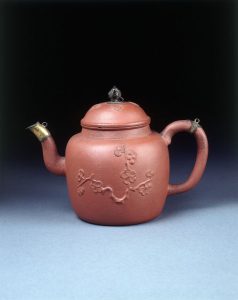
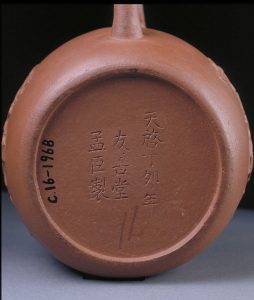
Fig.6
But the former claim that Hui Meng Chen lived between the Wanli and Chongzhen reigns is also wrong because Zhou Gao Qi, the famous Late Ming Zisha pot historian who died in 1646, did not mention Hui Meng Chen and his legendary small Zhuni pot in his book, “An Account of YangXian Teapots” (YangXian is the old name of Yixing).
During the Transition Period from 1620-1683, when porcelain production in Jingdezhen ceased and although the Imperial court stopped supporting the official kilns, private manufacturing of porcelain and other wares continued to meet the demands, including foreign trading companies from Europe, Japanese merchants and domestic customers.
As there are no archaeological or documented records available, this period is the most difficult for study or research. Fortunately, we have quite a considerable number of rescue-excavated tea ware from the Transition Period which are sufficient to shed light on not just the when, why, how and where Gong Fu tea started but also when Hui Meng Chen lived and made pots, especially his legendary small Zhuni pots.
We know that the early pots were made by Hui Meng Chen in late Ming – one of which is the High Lantern-shaped Zisha Pot found in the Victoria and Albert Museum, which was copied from Shi Da Bin’s earlier work, namely, the Wanli 35th year reign(AD 1607)High Lantern-shaped Zisha Pot (refer to Singaporean scholar John Ng’s work, ”The Evolution of the Shi Da Bin High Lantern-shaped Zisha Pot”), did not impress the Late Ming Zisha pots historian, Zhou Gao Qi, and that was why he did not mention Hui Meng Chen’s name in his book.
Therefore, with this reason and together with the fact that there were no small Meng Chen Zhuni pots found in late Ming era, we can safely conclude that the legendary small Meng Chen Zhuni pot must be created after the book, “An Account of YangXian Teapots” was written or after Zhou Gao Qi’s death in 1646 (Shunzhi 2nd Year Reign).
We know Hui Meng Chen made his early pots in late Ming, one of which was the Tianqi 7th year reign (1627) Zisha pot collected in the Victoria and Albert Museum and we know Hui Meng Chen later made his revolutionary small Meng Chen Zhuni pot just before the Meng Chen Zhuni copies appeared during Kangxi but exactly when later?
The answer is simple: 345 Pots or 49% of our excavated 705 Zisha pots are small Meng Chen Zhuni pots. Now the earliest of these small Meng Chen Zhuni pots is No:387 (we keep an inventory of pots using numbers) which is from the Shunzhi reign because it was excavated from a Shunzhi period grave. The first appearance of Meng Chen Zhuni copies, according to our exact-dated pots, was in Kangxi.
The gap of roughly between 10 to 20 years logically explains the time it took for the new and unknown small Meng Chen Zhuni pot to become famous and to be copied (or even forged) by other potters. The highest proportion of our Meng Chen Zhuni copies (in fact, disproportionately high) and they are almost all part of Gong Fu tea ware, belongs to the Qian Long period which indicates that there could very possibly be a mass production of the small Meng Chen Zhuni copies during the reign of Qian Long.
So, the timeline of the small Meng Chen Zhuni copies stretched from the Kangxi era, when they first appeared, to Qian Long when they peaked and to Daoguang when Santoh Zhuni pots replaced Zhuni pots as the most popular teapot used for drinking Gong Fu tea.
And we also found something else. There are many commemoration-like Meng Chen Zhuni pots with Emperor Qian Long’s 8th year reign mark, alongside the Meng Chen name (There is an Emperor Qian Long 13rd year reign Meng Chen Zhuni pot too, but it is not in Ren Fu Collection). This phenomenon is not surprising considering the overwhelming popularity of the Meng Chen name but what is surprising is that no other potters in Yixing history had an Emperor’s reign mark with their name on their pots because to use an Emperor’s reign mark with their name on the pot is only possible with the Emperor’s approval.
This was the first time in history that any pot received royal recognition. Emperor Qian Long was known to love drinking tea (Gong Fu tea) and for sneaking out from the palace to drink tea with the common folks.
But why was the royal recognition after Hui Meng Chen was long dead? Yes, the master potter was dead but his legacy was not. It has survived until today in unproven popular claims, documented history, sea-salvaged and unearthed Yixing teapots and now in Ren Fu Collection’s huge archaeological trove.
So could the small Meng Chen Zhuni pot which the master potter created, sparked off the tea making and tea drinking revolution called Gong Fu tea?
We have solved the mysteries of the small Meng Chen Zhuni pot and Hui Meng Chen so now we come to the third of the mysterious trilogy – the Gong Fu tea. When did Gong Fu Tea culture begin?
Our earliest excavated Gong Fu tea wares with exact dating, indicated it was from the early Kangxi period that Gong Fu tea started as claimed by most Chinese tea experts and it was also during Kangxi reign that the first Meng Chen Zhuni copies appeared, along with other Gong Fu tea ware.
To put it another way, our archaeological collection indicates that Gong Fu Tea came about during the early Kangxi period after the appearance of the first small Meng Chen Zhuni pot in Shunzhi (Pot no:387) which explains why most of our excavated Gong Fu tea sets contained a small Meng Chen Zhuni copy which peaked during Qian Long’s reign where over 80% of tea wares included a small Meng Chen Zhuni copy.
This correlation between the small Meng Chen Zhuni pot and Gong Fu tea must be more than symbiotic and more like a parent and offspring relationship, meaning the small Meng Chen Zhuni pot must have inspired the birth of Gong Fu tea.Gong Fu Tea, after it began in early Kangxi, spread rapidly especially after 1683 when the Emperor Kangxi restored order to the whole of China by capturing Taiwan, the last bastion of NanMing resistance.
Life thereafter returned to normal and with the growing prosperity which peaked in Qian Long’s reign, when Zhuni Pots became affordable and tea drinking (or rather the Gong Fu tea tradition) became an equal pursuit instead of just for the privileged.
And why and how did Gong Fu Tea begin?
In pre-Ming times, the popular tea drinking utensil was the chawan (big tea bowl). Tea was drunk on its own or mixed with other health-giving ingredients in the big bowl. Then during the Ming dynasty, Zhu Yuan Zhang, the first Emperor who was a former monk, decreed that tea leaves be used instead of tea bricks/cakes in making tea to save energy, time and money.
The effect of the Imperial edict was immediate. Tea wares evolved to suit the tea leaves, like the invention of the Gaiwan (lidded bowl) to steep and drink tea from. Then in late Ming era the Yixing teapot or Zisha Hu as the Chinese prefer to call it, was invented which was a big Zisha pot for steeping tea leaves and the tea poured into and drank from smaller chawan(or big teacup as Song chawan were big tea bowls).
Finally in Shunzhi, Hui Meng Chen created the first small Zhuni pot using a special clay called Zhuni and the very small size of the Zhuni Pot immediately created a domino-effect on other tea wares – big teacups became smaller, big water boilers became smaller and big stoves were reduced in size (as proven by our collection of unearthed tea wares).
And these four tea wares together with a fifth which was a small dish (tea boat for putting the small Zhuni pot and small teacups) became known as Gong Fu tea ware to be used for making Gong Fu tea.
How do we know the unearthed tea ware were Gong Fu tea ware?
Simple. According to our recorded excavations, almost all of our unearthed cultural relics from late Ming to Daoguang graves/tombs were tea ware. However only in graves/tombs from early Kangxi to Daoguang did we find tea ware consisting of five tea utensils(Fig.7), namely, the Zhuni Pot, teacups, dish, water boiler and burner( or tended towards a consistent five piece set of tea ware because some pieces were lost during or before excavations due to unfortunate circumstances like demolition of graves/tombs by bull-dozers or human errors in excavations while rescue efforts were underway). Even five piece tea ware were found in poor graves in the form of miniature funereal objects.(Fig.8)
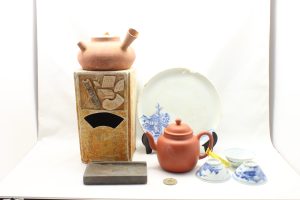
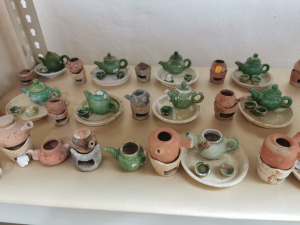
Fig.7,8
This sudden change and quiet tea culture movement towards universal use of five tea utensils during the civil wars of the Transition Period(1620-1683) constituted a silent but momentous revolution in tea culture. And that tea culture revolution was Gong Fu tea and the tea ware used was Gong Fu tea ware.
Whether Gong Fu Tea was tea art or Cha Dao or both (or even tea ceremony), is open to more in depth studies which we hope to do in the future with research professors from universities and museums.
Indeed, our archaeological trove contains more undiscovered facts than we have discovered. For example, we have archaeological proofs of who invented Gong Fu Tea and where exactly it originated from or that we found that all our SiTing Zhuni pots belonged to women and we have pots made by unheard of woman potters.
We also have abundant archaeological evidence to prove Hui Meng Chen fathered a son named Hui Yi Gong during the early Kangxi era, who went on to become a prolific potter himself. Some people say that Hui Yi Gong is the most underrated master potter, creating works in late Kangxi and Yongzheng era, mostly imitating his father’s works.
REN FU COLLECTION PROVES GONG FU TEA HAD SPREAD AROUND THE WORLD
Silk was China’s first main export in ancient times but the exports of the fabric began to decline after the Tang Dynasty (608-907) when silk making techniques spread to central and southern Asia and Europe. Then came porcelain and its popularity surpassed that of silk in the latter part of the Silk Route trade. Chinese porcelain was exported to Japan, the Korean peninsula, South-East Asia, Western and Central Asia, East and North Africa, and Europe.
The “Porcelain Road”- 16th and 17th Century Trade Route by Sea – was from where Europe got its tea.
By the mid-18th century, the primary export of China was tea including Gong Fu tea wares like Yixing teapots, teacups and saucers. Some 90% of the exchange currency was in silver which put great economic pressure on Europe to start producing their own porcelain tea ware to compete with China, while still buying export tea wares from China.
How did Gong Fu tea spread to Europe? It was by direct trade with China or through trading hubs like Malacca or Palembang in South-east Asia.
The evidence is in our archaeological trove of unearthed Gong Fu tea wares. We found many Chinese export tea wares like tea cups and dishes, besides Yixing teapots, made for European markets and vice versa. That is, European versions of Gong Fu tea wares made by Europe for the Chinese and South-east Asian market and their own domestic market. (Fig. 9 , 10 and 11)
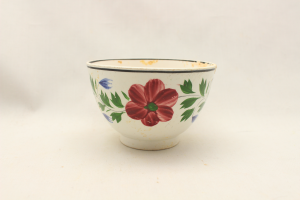
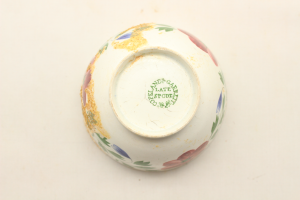
Fig.9
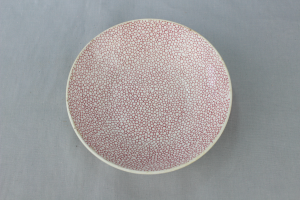
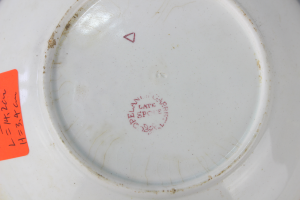
Fig.10
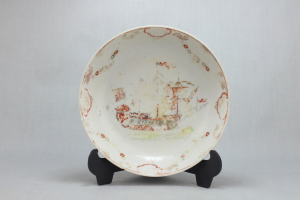
Fig.11
In addition to this, there are 18th century pictorial accounts of the European versions of Gong Fu tea drinking in paintings collected in European museums. An example of this is a circa 1715 painting of “Two Ladies and an Officer Seated at Tea”,in the collection of Victoria and Albert Museum. (Fig.12)
Two Ladies and an Officer Seated at Tea; Dutch School;
Paintings Collection Victoria and Albert Museum, c..1715
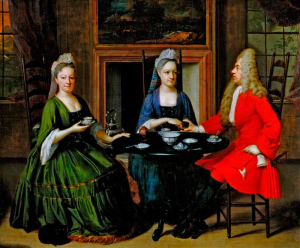
Fig.12
This simply means that Gong Fu tea had spread to Europe in the 18th century and by the 19th century Europeans had created their own version of Gong Fu tea, like for example the British tea tradition where Gong Fu tea had morphed into the British method of making and drinking tea.
Yes, one would have imagined that in global trading, not only were goods bought and sold but there were also exchanges of ideas, knowledge, cultures, art, inventions, and so on. This means that European potters must have known about Gong Fu tea to copy or produce competitive versions of Gong Fu tea wares for their own domestic market and foreign markets especially one as demanding as the Chinese market (both in mainland China and in South-East Asia which had the largest Chinese immigrant community outside China).
N.B.The physical form of Gong Fu tea consisting of a Yixing teapot, teacups and dishes(saucers) spread to Europe whereas in China, Gong Fu tea, besides its physical form, also incorporated tea art and cha dao.
CONCLUSION
Out of the three mysteries – Gong Fu Tea, the legendary small Meng Chen Zhuni pot and master potter Hui Meng Chen – tracing the famed potter’s life history was the most difficult. Hui Meng Chen’s history was very opaque except for two important documented clues.
The two clues were the Tianqi 7th year reign (1627) Hui Meng Chen Zisha pot collected in the Victoria and Albert Museum, London and a book, “An Account of YangXian Teapots”, written by the famous Late Ming Zisha Hu historian Zhou Gao Qi who died in 1646.
These two documented clues proved that Hui Meng Chen was making his first Zisha pots (not small Zhuni pots) during the Tianqi reign and whatever pots he made in late Ming did not merit a mention in the book written by the famous Late Ming Zisha Hu historian.
Hui Meng Chen was the most popular, most famous and most idolised old master potter in the history of Zisha pots and whose small Meng Chen Zhuni pot was believed and now archaeologically proven to be the most important in Gong Fu Tea.
Historian after historian from the past until now tried but failed to trace Hui Meng Chen’s life. The reason is that nothing was documented about Hui Meng Chen’s life or his invention of the small Meng Chen Zhuni pot or the birth of Gong Fu Tea in the Transition Period (1620-1683) because of civil wars in China and also Jingdezhen and other major kilns were officially closed then, which meant any business conducted, domestic or foreign, had to be private and clandestine.
As such,Hui Meng Chen lived in myth and folklore, until now when new archaeological evidence has become available from the Ren Fu Collection.
According to our archaeological trove, out of 705 excavated pre-Daoguang Yixing teapots with exact date and recorded archaeological details, 345 are Meng Chen Zhuni copies except for one small Meng Chen Zhuni pot No:387 which was excavated from a Shunzhi period grave. We believe Pot No:378 must be the real small Meng Chen Zhuni pot made by Hui Meng Chen himself because it belonged to that short period between Zhou Gao Qi’s death in 1646 and the birth of Gong Fu tea in early Kangxi, where we have strong evidence that that was when the first legendary small Meng Chen Zhuni Pot was created.
Except for the earliest excavated Shunzhi small Meng Chen Zhuni pot (Pot no:387) the other 345 Pots are Meng Chen Zhuni copies which were excavated from Kangxi, Yongzheng, Qian Long, Jiaqing and Daoguang graves/tombs and there were no Zhuni pots with the Meng Chen name in our collection excavated from Late Ming graves/tombs.
Almost all our 345 Meng Chen Zhuni copies were part of Gong Fu tea wares. These high numbers of small Meng Chen Zhuni copies and the earliest Gong Fu tea wares in our archaeological trove helped us to pinpoint the exact timelines for when Gong Fu Tea started and when the small Meng Chen Zhuni copies started to appear.
With these two timelines, we can work out when the real small Meng Chen Zhuni Pot was invented, which must be between either after Zhou Gao Qi’s book was written or after his death and before the first appearance of the small Meng Chen Zhuni copies.
Finally, we can now work out accurately that Hui Meng Chen made his Tianqi 7th year reign Zisha pot (found in the Victoria and Albert Museum) in his twenties or thirties, and later in Shunzhi reign made his legendary small Meng Chen Zhuni pot in his fifties or sixties.
Even though all evidence points to Shunzhi as the period that Hui Meng Chen made his first small Meng Chen Zhuni pots in his twilight years, estimated to be in his fifties or sixties but whether he still made small Zhuni Pots during the early Kangxi era, is open to debate (even though we have a possible early Kangxi Meng Chen Pot no:438 which could be the real small Meng Chen Zhini pot).
Nevertheless there was a famous late Kangxi potter, with the same surname – Hui Yi Gong, whose works bore an uncanny resemblance to Hui Meng Chen’s works. And Hui Yi Gong was born during the early Kangxi period, so could Hui Meng Chen have fathered a son and that son was Hui Yi Gong?
Lastly, as to the question of whether Gong Fu tea was tea art or Cha Dao or even tea ceremony, we believe the ingenious Chinese mind which has given us the Tang dynasty tea sage Lu Yu and his first world treatise on tea, “Classic of Tea”, surely must have been able to create a tea art, Cha Dao or tea ceremony, one would have imagined, to go with their glorious inventions. And even though Hui Meng Chen and his invention, the small Zhuni Pot, which was the source of inspiration to the birth of Gong Fu tea, were all shrouded in mystery amidst the fierce battles between the last NanMing forces and advancing Qing army, Chinese tea culture ingenuity was not suppressed but found escape routes to foreign lands where Gong Fu tea influenced and inspired the rise of foreign national tea cultures through trading hubs like Malacca, Semarang and Palembang in Nanyang, making tea the most consumed beverage in the world and one of the most shared human experience.
#Original research work by Tony B.S.Gim based on Ren Fu Collection’s archaeological trove.
一、17 世纪末茶革命(称为“功夫茶”)的考古发现
关于历史上是否存在功夫茶的问题,存在着很大的争议。
加拿大阿尔伯塔大学著名教授Jean DeBernardi在台湾蒋经国基金会和阿尔伯塔大学的资助下,对功夫茶进行了研究。
她得出的结论是,功夫茶是台湾最近的一项发明,受到与日本接触的影响。
另一方面,厦门大学严利人教授及其学术团队并不认同DeBernardi博士的研究结果。
他们认为功夫茶起源于 17 世纪,起源于中国福建漳州。
然而,其他茶专家对此提出异议,声称功夫茶是潮州人传承至今的古老发明。
DeBernardi教授对历史上是否存在功夫茶的怀疑是正确的,因为没有任何文献证据。
唯一的考古证据是出土的鸣远款宜兴小茶壶,和出土四个若深茶杯(小瓷杯,由康熙时期一位名叫若深的陶工首次制作),以及一个盘子。 考古发掘在中国福建漳浦县赤岭镇乾元村的蓝国威墓,墓志铭“乾隆二十三年”(公元1726年)(见南京博物院《砂壶汇赏》第82页),并不能证明或不是足以证明历史上存在过功夫茶。
但当任富收藏出现后,事情发生了变化,并以其巨大的出土功夫茶具考古宝库震惊了世界。
二、神秘的三位一体和孟臣现象
我们的出发点不是为了寻找惠孟臣,也不是为了寻找传说中的小孟臣壶,甚至不是为了寻找功夫茶的起源,因为我们一开始就不是一个研究机构。
我们是一支抢救队,专门从 20 世纪 70 年代至 90 年代南洋各国(东南亚)因住宅、商业和工业发展而面临拆迁的中国古墓葬遗址中抢救文物。
在发掘过程中,我们发现出土的文物几乎都是茶壶和其他茶器。我们不知道它们到底是什么,于是开始了实况调查。
我们去了香港、台湾、中国大陆和南洋地区,因为那里有相当多的中国茶客和茶艺界人士,所以我们对可能涉及的主题有了一些了解,特别是我们的出土文物(几乎包括所有茶器)可能是茶文化的一部分。
我们咨询了知识渊博的人士,阅读了大量书籍,但经过几年的事实调查,我们被三个谜团所困惑,当时我们还不知道它们之间有什么联系。
在中国饮茶界的任何地方,人们都会提到 “惠孟臣 “这个名字,在大多数海捞、出土或收藏的宜兴茶壶上,包括在书籍、拍卖会和博物馆中重点展示的茶壶上,都能找到这个名字。
看来,作为中国茶文化伟大的象征,真正的功夫茶必须使用孟臣朱泥小壶。 我们发现,到处都在不断提及孟臣这个名字,包括在我们抢救出土的大多数记录有考古细节的陶器中。(附图1, 2)
附图.1 附图.2
但所有这些都有一个问题:哪里有证据表明惠孟臣生活在什么时候,他是什么时候制作了他的传奇茶壶,甚至是功夫茶何时开始的问题?
这些反复出现的问题迫使我们将此事称为“神秘的三位一体”。
那么答案呢? 我们几乎不知道,我们一直在寻找答案——在我们出土的一千多个茶壶中,其中大部分都刻有孟臣的名字,而且这些壶大多是功夫茶具的一部分。
在进一步讨论之前,让我们先了解一下朱泥茶壶的意义。 道光以前的功夫茶具中,朱泥壶是最重要的。
三、什么是朱泥,小孟臣朱泥壶有什么特别之处?
宜兴茶具的世界充满了神话、误解、夸张、炒作,是艺术界中赝品最多的。
因此,对于刚接触宜兴茶具的人来说,了解制作宜兴茶壶所用的宜兴泥料是相当具有挑战性的。 在所有宜兴泥料中,也许最令人困惑的是朱泥,一种著名的橙红色粘土。
在网上搜索资料时,人们会发现“旧朱泥”与“现代朱泥”的说法令人困惑,朱泥已“灭绝”,而“现代朱泥”实际上是“红泥”或红泥和其他泥料的混合体,都叫宜兴粘土。
无论说法如何相互矛盾,红泥和朱泥只是两种不同的矿石,具有不同的矿物成分。
红泥是一种泥质粉砂岩,是一种由粉粒大小的颗粒形成的沉积岩,朱泥则是一种在其他沉积岩中混凝的泥岩,其颗粒大小为泥粒(比粉粒细)。原矿看起来大不相同,尽管两者在烧制时都会变红。
宜兴矿石烧成后收缩,红泥和朱泥矿石成分不同,收缩率有显著差异。平均而言,红泥的收缩率约为未烧制尺寸的15%,而朱泥的收缩幅度在17%至25%之间。
除了细小的颗粒尺寸外,这意味着烧制的朱尼也将明显更致密,其尺寸更重,表面更光滑,与红泥的沙子表面形成对比。有些人甚至声称朱泥壶有丝滑的感觉和玉一样的外观。不管有什么相互矛盾的说法,红泥和朱泥只是两种不同的矿石,具有不同的矿物成分。
尽管中国有许多地区发现了粘土矿床,但宜兴是唯一一个拥有适合制作茶壶的矿石的地区。此外,紫砂矿石并非随处可见。
开采矿石的地层仅位于海平面以下数百米处。 如此深的开采是危险的,如果不是对紫砂壶特别是朱泥壶的大量需求,开采就没有价值,中国的茶文化也会沿着不同的路线发展。
朱泥是最稀有的粘土,含铁量最高,但由于收缩率大,烧成后成功率最低。 朱泥壶,尤其是古董壶,是最昂贵的,受到收藏家和某些茶客的追捧。
在漫长的饮茶历史中,茶具的设计不断演变,定义了饮茶体验。 对茶的最高品质以及茶与茶具之间最高兼容性的追求只能在功夫茶文化中找到。
完美的功夫茶,或者说精髓的功夫茶,是用小孟臣朱泥壶冲泡,用若深茶杯喝的,正如清初功夫茶祖师们所认为的,作为最好功夫茶的标准。
茶艺专家认为,考验一个制壶者的技艺,在于壶的功能性和美观性。 喷嘴必须倒出时不滴水,手柄必须具有良好的抓握力并且握在手中感觉良好,最重要的是,盖子必须具有良好的贴合性。 艺术在于实现所有提到的要求的和谐平衡。
对任富收藏的编号387号壶(附图3,4)进行性能测试,我们有考古证明,它是顺治年间(1644-1662年)惠孟臣晚年制作的传奇小朱泥壶之一,它毫无疑问地通过了测试。我们发现,小小的孟臣朱泥壶,泡出的茶最新鲜、香气最好、色泽最好、最快,这标志着当时惠孟臣在宜兴茶壶设计和宜兴泥塑工艺上的一种突破。惠孟臣的目标是生产出一个最适合转型后期(1620-1683)内战中严酷生活的茶壶,尤其是在福建,这是南明军队在中国大陆最后一个落入前进的清军手中的堡垒。在这种生活中,速度、警觉性和清晰的头脑对人类的生存至关重要。
Fig.3 and 4
此外,我们在考古宝库中还发现,孟臣朱泥小壶之所以具有传奇色彩,一个原因是它在和平与战争时期的多功能性。
在疯狂的内战中,小孟臣朱泥壶或任何其他小朱泥壶都可以单独使用——直接冲泡和饮用茶,不需要茶杯——也可以作为室内或室外功夫茶的一部分,也可以作为移动便携式旅行茶包的一部分——包括小茶壶、小茶杯、小碟(茶船)、小燃烧器(炉子)和小锅炉(水壶),用于在路上泡茶和饮用(这是通常的晚明紫砂大壶所不能做到的)。
N.B.我们的小孟臣朱泥壶号387的体积是100毫升,与我们的晚明紫砂壶号360的体积750毫升相比。
四、任富收藏的 1,190 个抢救出土的古代功夫茶具中记录了考古细节
任富收藏最初是一个救援队,更关心未来的学习和研究。 尽管我们没有受过训练,也不专业,但我们发掘千座墓中考古的丰富经验和知识帮助我们了解了过去。
我们以储存的考古细节的形式获得这些知识,包括大量数据和出土文物的确切年代。
我们希望,在发掘过程中出土的埋藏遗骸以及我们积累的过去人类活动的其他实物遗骸,能够帮助考古学家和历史专家更好地分析和重建过去。
我们的1190个茶壶,除了两个以外,都是道光以前的。 其中包括705件紫砂壶和485件汕头朱泥壶以及茶杯、茶盘、炉具、水壶等茶具。 虽然我们明末至顺治时期的紫砂壶都不是功夫茶具,但康熙早期至道光时期的大部分物品都是功夫茶具。(附图5)
附图.5
在我们的705把紫砂壶中,有345件(约49%)是孟臣朱泥壶,几乎所有孟臣朱泥壶都是功夫茶具的一部分。
虽然出土文物以功夫茶器居多,但有时也出土一些非功夫茶器,包括玉器、不同民族的钱币、鸦片烟斗、茶罐、清朝官方头饰,甚至偶尔还出土遗骨。
人类遗骸对于未来的 DNA 测试至关重要,例如,可以确定与传奇历史人物郑成功或郑族(1624-1662)的血缘关系的真实性。
至于老孟臣壶的产量估算,有专家和专业人士声称。事实上,无论是出土的、海上打捞的还是博物馆里的,都来自中国古老的墓地,这些墓地有数以千计,这些墓地被推土机大量摧毁,为现代发展让路。 据说,许多人仍然在沉船的船体中或埋在墓出土的。
最后,请注意,为了本次研究的目的,我们的重点是过渡时期(1620年至1683年)出土的茶具,这一时期中国茶文化发生了革命,处于混乱和动乱之中。
正如大英博物馆馆长索米·詹尼斯 (Soame Jenyns) 在 1955 年的作品调查结果中所写:“按照我的定义,从明朝灭亡到清朝崛起的过渡时期是从明朝灭亡开始的。 从1620年明十四世皇帝万历皇帝上位,到1683年清康熙二十一年任命张应宣为景德镇御瓷厂厂长。在这动荡的63年里,我们对景德镇发生的事情知之甚少,它的历史被明朝灭亡的王朝斗争和继承它的清朝的惨痛所笼罩。”
值得注意的是,转型时期,不仅江西世界瓷都景德镇的窑址受到内战的影响,江苏宜兴等中国陶都也受到内战的影响。
- 中国茶文化发展简史
在唐代陆羽时代之前,中国人就知道如何种植最好的茶树。 唐宋时期,他们懂得用最好的茶叶制成饼或砖,磨成粉末来泡茶。 随着他们的知识不断增长和提高,他们泡茶和喝茶的艺术和技术也不断提高。
这种制茶和饮茶的演变或变化可以从唐代开始观察到,当时将茶粉煮沸,加入草药,倒入碗中饮用。 在宋代,人们将热水倒入一碗粉茶中,搅拌后饮用。
明代,茶史发生了一场革命。 皇家法令禁止生产饼茶,而是将茶叶加入沸水中浸泡,而不是粉茶,这与我们今天泡茶的方式类似。
明朝第一任皇帝出身于僧侣,出身于贫困家庭,他下令即使是平民也应该能够享受茶文化,这使得茶不仅成为精英和特权阶层的平等追求,也成为普通百姓的平等追求。
泡茶饮具也发展出不同的种类,从唐宋时期常见的茶碗,到明代发明的盖碗。
紫砂壶发明于明朝末年,最后顺治年间陈惠孟发明了革命性的小朱泥壶。 陈惠孟发现了一种用新的朱泥粘土制作紫砂壶更小、更精致的不同方法,这一创作被称为小孟陈朱泥壶。
在内战时,用这种方式,茶叶在小锅中冲泡,茶叶与水的比例更高,从而使茶更浓郁、更鲜、更浓、更香,更重要的是,在匆忙的时代里可以更快地冲泡。
这引发了康熙初期的饮茶革命,即“功夫茶”,用最好的茶具和茶叶,泡出最好的茶。 工夫茶的五件茶具是小朱泥壶、茶杯、茶盘、开水器、炉子。
清初非常繁荣,不仅朱泥壶比以往任何时候都更容易买到,而且朱泥壶的产量也更大,其中大部分是小型孟陈朱泥壶,根据我们的考古发现,朱泥壶在乾隆统治时期达到了顶峰,因此 让功夫茶成为贵族、文人墨客、平民百姓都能享用的实惠消遣。
这场革命并没有逃过欧洲等世界其他地区的关注。 宜兴茶壶和茶具,如精美的陶瓷茶杯、茶碟,在18世纪的欧洲受到人们的追捧和推崇,只有皇室和贵族才能拥有。 这在乾隆统治时期欧洲中国风的鼎盛时期最为明显。
- 茶道:茶之道
当大多数从业者想到茶文化时,他们会想到“茶道”这个词。 更具体地说,当他们想到特定国家的茶文化时,他们会想到中国的“茶艺”、韩国的“茶道”和日本的“茶道”。
中国人和日本人都将唐代的陆羽视为茶圣、茶道鼻祖,而韩国人则将神农视为茶圣。
然而,这个词陆羽的《茶经》中从未出现过“茶道”。 只是说茶适合精行俭德的人。 有人认
陆羽的“精行俭德”是茶道的主要内容。
茶刀的首次提及出现在著名茶艺家、诗人、陆羽挚友觉然和尚的一首诗中。 据说,喝了第一杯茶,娇然就从世俗的幻想中醒悟; 第二个净化了他的精神,就像春雨净化了大地一样; 第三杯带来了启蒙,消除了考虑摆脱痛苦和困难的需要。 (一饮涤昏眠,情思朗爽满天地;再饮清我神,忽如飞雨洒清尘;三饮净化道,何须苦心破烦恼)。 这是第一次提到茶道,意思是通过茶悟道。
我们出土的许多清代早期的工夫茶器,如朱泥壶、茶杯、茶盘、炉等,都刻有茶道诗,这表明工夫茶既是一种茶艺,又是一种茶道,在清初都达到了顶峰。 清朝时期,尤其是乾隆年间。
七、功夫茶文化革命中的政治与战争
进一步了解清顺治至康熙早期的目的有三个原因。 一是帮助寻找惠孟臣传说中的小朱泥壶,二是帮助寻找功夫茶的起源和发明者。 第三个原因是要了解为什么朱泥壶不是宜兴制造的,而是在哪里制造的。
清顺治/康熙早期的政治和战争是否影响了惠孟臣小朱泥壶的发展并影响了功夫茶的诞生,目前尚无定论,但任富收藏有强有力的考古证据表明事实确实如此。
清朝是中国帝国历史上最后一个王朝。 它于 1636 年在满洲(今中国东北)成立。 到 1644 年,其统治范围扩展到中国本土,一直持续到 1912 年。清朝之前是明朝,继而是中华民国。
16世纪,爱新觉罗王朝领袖努尔哈赤开始组织“旗”,这是包含满族、汉族和蒙古族元素的军事社会队。 努尔哈赤联合氏族,建立了满族的民族认同,并于1616年正式建立后金王朝。
1636年,他的儿子皇太极宣布清朝。随着明朝的控制因腐败和内讧而瓦解,明朝将军李自成领导的农民起义军于1644年攻克北京,但明朝将军吴三桂打开了山海关, 摄政王多尔衮的军队击败了叛军,占领了首都,并接管了政府。
由于南方明朝忠臣的抵抗和三藩的叛乱,直到1683年才完全征服明朝。(我们特别感兴趣的是最后福建和台湾的投降)。
以下是清朝从建国到康熙初期的简要时间线。
1.努尔哈赤于1600年创建了由满族、汉族、蒙古族组成的八旗军。
2.努尔哈赤于1626年9月30日去世。
3.1627年初皇太极当选可汗。
4.皇太极将所有女真部落统一为满洲,结束了女真人的统治。
5.1636年4月皇太极宣布清朝。
6.1638年清朝征服山东。
7.1643年,中国东北地区归顺清朝。
- 1644年5月27日山海关之战,吴三桂放清军过长城,打败李自成,李自成逃往北京。
- 清军占领北京,李自成于1644年6月5日逃走。
- 1644年,中国南部和西部的大部分地区被封为三位援助清明朝将军的封地。 这三个封臣分别由吴三桂、耿精忠、尚之信控制。
11.1645年1月清军攻克洛阳; 1645年5月20日,扬州; 南京和弘光帝于1645年6月16日,杭州于1645年7月6日。
12.清军于1646年9月30日攻占延平,隆武帝于1646年10月6日被清军杀害,清军占领福州。
13.清军于1647年1月20日占领广州和邵武皇帝,于1647年3月5日占领广东、广西的一半和海南,于1647年3月占领长沙,于1647年9月23日占领武冈。
14.清军于1649年3月1日占领南昌,于1649年11月24日屠杀广州人民,于1649年11月27日占领桂林,占领肇庆,永历皇帝于1649年12月2日逃亡。
15.清军攻克舟山,朱一海于1651年10月15日出逃。
- 1659年3月10日,清军占领永昌和云南。
17.郑成功于1659年8月10日攻占镇江,并于1659年8月24日围攻南京,但郑成功的军队被歼,他于1659年9月9日撤退到厦门。
18.郑成功于1661年进攻台湾的荷兰殖民者,建立东宁王国(今台南)。
- 1662年5月,永历皇帝在云南被俘并被处决。
20.郑成功于1662年6月23日去世。
- 1664年清军攻克福建,郑经退守台湾。
- 1683年清军进攻台湾,东宁王国第三位也是最后一位统治者郑克爽投降,被封为汉郡公,并在北京度过了余生。
顺治时期,清朝统治尚未完全,华南地区,特别是福建和台湾是南明统治下的最后两个据点。 康熙二十二年(1683年),全中国合而为一。
从任富收藏考古宝库的发现来看,我们相信有证据表明,在福建和台湾沦陷期间,可能有两次福建人分别为躲避战乱和动乱而迁徙到南洋地区。 (请注意,在逃亡者中也有其他中国人,如广东人、潮州人、客家人等)。
最后,每个紫砂壶学者和考古学家都想问的问题:宜兴羊角山考古发掘中没有发现朱泥壶。 这是否意味着朱泥壶不是宜兴制造的,尤其是顺治至康熙初期朱泥壶首次出现的时期? 如果是的话,朱泥壶是哪里制造的?
难道这些就是线索吗?
现有出土茶壶1190件,其中宜兴茶壶705件。 其中,以朱泥壶居多,又以孟臣仿品居多。
孟臣朱泥复制品大部分出土于福建坟墓,最早、最好的功夫茶具也出土于福建坟墓。 从数量上看,705件宜兴紫砂壶中,有345件是孟臣朱泥仿品,占49%。
那么,惠孟臣等宜兴老陶匠是否会跟随撤退的南明军队来到福建,并留在当地继续制作茶壶呢?
据中国陶瓷历史学家许文进介绍,17世纪,尤其是过渡时期(1620-1683年)是一个特别令人感兴趣的时期,当时发生了许多变化,影响了中国陶瓷中心景德镇的瓷器生产。
然而,能够让我们更好地了解这一时期的记录、年代资料或考古发现却很少。 这个问题从万历末期到1683年左右恢复景德镇监察,即所谓的过渡时期尤为严重。
因此,这一时期的瓷器年代至今仍存在争议,而这一争议却被忽视了,除了中国陶瓷史书籍中的几句话外。 这种态度在中国流行,部分原因是缺乏可供研究的物质证据。
值得庆幸的是,这一时期的中国瓷器从传到他们国家的那一刻起就受到了西方人的高度评价,这种持久的热情导致了人们对这一时期考古发现的认识和寻找的提高(任富收藏中有很多这样的考古发现)。
奇怪的是,国内外市场对景德镇瓷器的需求仍然很大。 尽管政治局势非常不利,影响了工作条件不利的是,景德镇工业仍然蓬勃发展,技艺精湛的陶工参与了私人窑炉的工作。
八、惠孟臣和周围的谜团
在任何陶艺家的历史上,从来没有出现过像惠孟臣这样的谜团。 他身上的谜团让当代历史学家感到困惑,就像过去一样。
毫无疑问,这位老陶艺大师是最有名的、最受欢迎的、最受崇拜的。 现在,根据我们出土的大量功夫茶具的考古财富,我们相信惠孟臣可能是有史以来最伟大的中国陶艺家。
以下是过去和现在试图解开惠孟臣难题或暗示他的伟大的尝试:
- 2004年,台湾著名学者黄健亮在南京博物院与台湾麦氏基金会合着的《紫砂壶鉴赏》一书中,声称惠孟臣一定是清代早期陶艺家,因为 明末著名历史学家周高启在他的《阳羡茶壶系》一书中并未提及他的名字,但后来在伦敦的维多利亚博物馆和阿尔伯特博物馆发现了一件有记载的明朝天启七年(1627年)惠孟臣紫砂壶时,发现其名字有误。。
他接着说,用他的话来说,尽管有成千上万的惠孟臣的壶这一现象,让人们感到困惑“崇拜孟臣茶壶”,但这只是考古挖掘可以解决这个难题。(第40和41页)
2.台湾历史学家连衡(1878-1936)盛赞孟臣壶,称工夫茶必须有孟臣壶,而孟臣壶最为珍贵。(第40页)
3.清代周恺写道:喝茶习惯用精致的茶具,茶壶必须是孟臣的。 (第 40 页)
4.漳州科技大学特聘教授杨立仁点评了困扰笔者十余年的工夫茶之谜。 他咨询了很多专家,查阅了很多资料。 他发现:工夫茶是一种新的泡茶和喝茶方式。 最早有文字记录的泡茶方法是清初原福建同安知县彭光斗于乾隆三十一年所著的《民所一》一书。 (1766)。 他在书中描述了在陇西(今漳州)看到老人们用小孟陈壶泡茶、用小茶杯喝茶。
5、关于孟臣茶壶的最早记载,见于吴谦(1733-1813)所著的《阳县名陶》中,他说:“我曾研究孟臣,得有“孟臣制”茶壶一只,及数件。 底部有其他汉字,但我不知道陈慧梦的年龄。 (第 41 页)
6、在中国研究宜兴陶艺的日本人敖蓝田只能在其著作《茶壶图集·缘起》(1878)中写道:惠孟臣生世已难考。 台湾著名学者黄前良评论道:傲蓝天之谜至今仍为世人所解。
浏览我们出土的数千件道光前期茶壶,其中记录了考古细节(包括其他出土的道光前期茶具和文物),就像穿越到了这一切发生的过去。
人们不需要火箭科学家的大脑就能想象内战期间陶艺家的日常生活场景,尤其是如果陶艺家和他的新作品——小孟臣朱泥壶非常有名的话。
惠孟臣一定是在保密的情况下辛勤地创造了他的新发明,避免公开,甚至放弃任何文件,因为担心被发现在反清或南明军队之间的内战中为敌人工作,这可能会导致 导致入狱甚至死亡。
请注意,在“三藩之乱”演变为内战之后,明朝军队于 1674 年摧毁了较大的窑炉和景德镇的大部分地区(根据历史记载),可能还有宜兴和德化窑等其他主要窑址。 。
恐惧和保密的“新常态”一直持续到1683年全中国恢复完全秩序,台湾沦陷,最后的南明军队被击溃,清朝统治下的中国成为一个国家。
此时,惠孟臣要么已经年老,甚至可能已经去世,只剩下他的作品以及他对朱泥壶和功夫茶的影响。 但遗憾的是,在我们的宝藏出现之前,没有任何记录,也没有考古发掘过惠孟臣朱泥小壶。
这就是为什么无论是当代还是古代的历史学家都无法追溯惠孟臣的作品,更不用说他的出生、制壶和死亡时间了。
下一部分解释了为什么需要考古发现传说中的小孟臣朱泥壶和功夫茶,有记载的历史和维多利亚和阿尔伯特博物馆的天启七年壶,著名的晚明紫砂壶历史学家和大量的考古资料。 寻找有史以来最难以捉摸、可能也是最伟大的中国陶艺家的发现。
九、寻找功夫茶、传说中的小孟臣朱泥壶和最难以捉摸的老壶大师
关于陶艺大师惠孟臣的思想有两种流派。 一说他生活在万历至崇祯年间,一说他生活在康熙至雍正年间。
南京博物院与台北市麦氏基金会合着的《砂壶汇赏》一书中,台湾著名学者黄健亮声称惠孟臣是清代早期陶艺大师(第41页),但后来在伦敦维多利亚和阿尔伯特博物馆发现了天启七年(1627年)惠孟臣紫砂壶后,这一说法被证实是不正确的。(Fig.6)
Fig.6
但前者认为惠孟臣生活在万历至崇祯年间的说法也是错误的,因为于 1646 年去世的晚明著名紫砂壶历史学家周高起在他的书中并没有提到惠孟臣和他的传奇小朱泥壶。 《阳羡茗壶系》(阳羡是宜兴的旧称)。
1620年至1683年的过渡时期,景德镇的瓷器生产停止,尽管朝廷停止支持官窑,但瓷器和其他制品的私人制造继续满足需求,包括欧洲的外贸公司、日本商人和国内的瓷器制造商和顾客。
由于没有考古或文献记录,这一时期是研究或研究最困难的时期。 幸运的是,我们有相当数量的转型时期抢救出土的茶具,足以说明功夫茶起源于何时、为何、如何、何地,以及惠孟臣生活和制壶的时间, 尤其是他的传奇小朱泥壶。
我们知道,明末早期的壶是惠孟臣本人制作的,其中一件就是维多利亚和阿尔伯特博物馆发现的高灯形紫砂壶,它是仿照时大彬早期作品万历三十五年制作的。 元年(公元1607年)高灯笼紫砂壶(参考新加坡学者吴约翰的著作《时大彬高灯笼紫砂壶的演变》),并没有给明末紫砂壶史学家周高启留下深刻印象 ,所以他在书中没有提到惠孟臣的名字。
因此,据此,再加上明末未见小孟臣朱泥壶的事实,我们可以断定,传说中的孟臣朱泥小壶一定是在《阳羡茗壶系》一书之后创制的。 ”是在周高启死后写的1646年(顺治二年)。
我们知道惠孟臣早期的壶作于明末,其中一件是收藏于维多利亚和阿尔伯特博物馆的天启七年(1627)紫砂壶,我们知道惠孟臣后来制作了他革命性的小孟臣朱泥壶。 孟臣朱泥壶在康熙时期出现之前,但具体是什么时候呢?
答案很简单:我们出土的705件紫砂壶中有345件,即49%是小孟臣朱泥壶。 现在这些小孟臣朱泥壶中最早的是No.387(我们用编号来盘点壶),它是顺治时期的,因为它是从顺治时期的坟墓中出土的。 据我们的确切年代来看,孟臣朱泥仿品的首次出现是在康熙年间。
大约10到20年的差距逻辑地解释了新的、不知名的小孟臣朱泥壶成名并被其他陶艺家复制(甚至伪造)所需的时间。 我国孟臣朱泥壶复制品所占比例最高(事实上是高得不成比例),而且几乎都是功夫茶具的一部分,属于乾隆时期,这表明小孟臣朱泥壶很可能会大量生产。 朱泥于乾隆年间仿制。
所以,小孟臣朱泥壶的制作时间线从最初出现的康熙年间,一直到鼎盛时期的乾隆,再到道光年间汕头朱泥壶取代朱泥壶成为最流行的功夫茶饮用茶具的时期。
我们还发现了其他东西, 类似纪念款的孟臣朱泥壶,有乾隆八年款,并有孟臣名字(乾隆十三年孟臣朱泥壶也有,但任富收藏中没有)。 考虑到孟臣这个名字的压倒性知名度,这种现象并不奇怪,但令人惊讶的是,宜兴历史上没有其他陶艺家在壶上刻有皇帝年号,因为在壶上使用了皇帝年号,只有得到皇帝的批准才有可以制作。
这是历史上第一次孟臣朱泥壶获得皇家认可。 乾隆皇帝爱喝茶(功夫茶),并经常偷偷溜出皇宫与百姓喝茶。
但为何惠孟臣死后才得到皇室认可呢? 是的,陶艺大师死了,但他的遗产却没有。 它一直存在于未经证实的流行说法、有记载的历史、海上打捞和出土的宜兴茶壶中,现在还存在于任富收藏的巨大考古宝库中。
那么,陶艺大师所创的孟臣朱泥小壶能否引发一场功夫茶的制茶和饮茶革命呢?
我们已经解开了小孟臣朱泥壶和惠孟臣的谜团,现在我们来看看神秘三部曲的第三部曲——功夫茶。 功夫茶文化从什么时候开始?
我们出土的最早有确切年代的功夫茶器表明,正如大多数中国茶学家所说的那样,功夫茶始于康熙年间,而第一批功夫茶具孟臣朱泥壶仿制品也正是在康熙年间出现 。
换句话说,我们的考古收藏表明,工夫茶是在康熙初期出现的,顺治时期出现了第一只小孟陈朱泥壶(壶号:387),这就是为什么我们出土的功夫茶大部分都是这样的。 茶具中含有小品孟臣朱泥,在乾隆年间达到顶峰,80%以上的茶具都含有小品孟臣朱泥。
小孟臣朱泥壶与功夫茶之间的这种关联,一定不仅仅是共生关系,更像是亲子关系,也就是说,孟臣朱泥小壶一定是功夫茶诞生的灵感来源。功夫茶,始于康熙初期,尤其是1683年康熙皇帝攻占南明抵抗最后堡垒台湾恢复全中国秩序后,迅速蔓延。
此后,生活恢复正常,社会日益繁荣,在乾隆统治时期达到顶峰,朱泥壶变得买得起,喝茶(或者更确切地说,功夫茶传统)成为一种平等的追求,而不仅仅是特权阶层的专利。
为什么以及如何开始功夫茶?
明代以前流行的茶器是茶碗。茶可以单独饮用,也可以在大碗中与其他有益健康的成分混合饮用。然后在明朝,第一位皇帝朱元璋,一位前僧侣,下令在泡茶时用茶叶代替茶砖/蛋糕,以节省能源、时间和金钱。
诏书的效果立竿见影。茶器的演变是为了适应茶叶,比如盖碗的发明,用来浸泡和喝茶。晚明,宜兴茶壶或紫砂壶(中国人更喜欢称之为紫砂壶)被发明了,这是一种用来浸泡茶叶的大紫砂壶,茶倒进较小的茶碗(或大茶杯,宋茶碗是大茶碗)中饮用。
最后在顺治,惠孟臣用一种叫做朱泥的特殊粘土制作了第一个小朱泥壶,朱泥壶的非常小的尺寸立即对其他茶器产生了“多米诺骨牌效应”——大茶杯变小了,大锅变小了和大炉子变小了(我们的出土茶器收藏证明了这一点)。
这四件茶具,加上第五件是一个小碟(放小朱泥壶和小茶杯的茶船),就被称为功夫茶具,用来制作功夫茶。
我们怎么知道出土的茶器是功夫茶器呢?
易于理解的根据我们的发掘记录,从明末到道光时期,我们出土的文物几乎都是茶器。然而,只有在康熙初年至道光年间的墓中,我们才发现由五件茶具组成的茶具(图7),即朱泥壶、茶杯、盘子、煮水器和燃烧器(或倾向于一致的五件套茶具,因为在挖掘过程中或之前,由于推土机拆除坟墓或救援工作中挖掘时的人为失误等不幸情况,一些茶具丢失了)。甚至在简陋的墓中也发现了五件式茶器,它们都是微型陪葬品。(图8)
附图.7,8
过渡时期(1620-1683)的内战中,这场突然的变革和平静的茶文化运动走向了五件茶具的普遍使用,构成了一场无声但意义重大的茶文化革命。那次茶文化革命就是功夫茶,使用的茶器就是功夫茶器。
功夫茶究竟是茶艺,还是茶道,或者两者兼而有之(甚至茶道),我们都希望在未来与大学和博物馆的研究教授们一起进行更深入的研究。
事实上,我们的考古宝库包含了比我们发现的更多的未被发现的事实。例如,我们有考古证据证明是谁发明了功夫茶,它到底起源于哪里,或者我们发现我们所有的思亭款朱泥壶都属于女性,我们有闻所未闻的女性陶工制作的壶。
我们也有大量的考古证据证明,惠孟臣在康熙初年有一个儿子,名叫惠逸公,后来成为了一名多产的陶工。有人说,惠逸公是最被低估的陶工大师,创作于康熙末年和雍正年间,大多模仿其父的作品。
- 任富收藏证明功夫茶已传遍世界
丝绸是中国古代的第一个主要出口产品,但唐代(608-907)丝绸制造技术传播到中亚、南亚和欧洲后,织物的出口开始下降。 随后出现了瓷器,在丝绸之路贸易的后期,其受欢迎程度超过了丝绸。 中国瓷器远销日本、朝鲜半岛、东南亚、西亚和中亚、东非和北非以及欧洲。
“瓷器之路”——16世纪和17世纪的海上贸易路线——是欧洲获取茶叶的地方。
到18世纪中叶,中国的主要出口产品是茶叶,包括宜兴茶壶、茶杯和茶碟等功夫茶具。 大约90%的外汇货币是白银,这给欧洲带来了巨大的经济压力,他们开始生产自己的陶瓷茶具与中国竞争,同时仍然从中国购买出口茶具。
功夫茶是如何传入欧洲的? 它是通过与中国的直接贸易或通过东南亚的马六甲或巨港等贸易中心进行的。
证据就在我们出土的功夫茶器考古宝库中。 我们发现,除了宜兴茶壶外,许多中国出口的茶具,如茶杯和茶盘,都是为欧洲市场制造的,反之亦然。 即欧洲为中国、东南亚市场以及本国市场生产的欧版功夫茶具。 (附图9、10、11)
除此之外,欧洲博物馆还收藏有18世纪欧洲版功夫茶饮用图画。 维多利亚和阿尔伯特博物馆收藏的一幅大约 1715 年的画作《两位女士和一位坐在茶旁的军官》就是一个例子。 (图12)
附图. 12,两位女士和一位军官坐在茶旁; 荷兰学校;
维多利亚和阿尔伯特博物馆的绘画收藏,约 1715 年
这仅仅意味着功夫茶在 18 世纪传播到欧洲,到 19 世纪欧洲人创造了自己版本的功夫茶,例如英国的茶传统,其中功夫茶已演变成英国的制作方法和喝茶。
是的,人们会想象,在全球贸易中,不仅有商品的买卖,还有思想、知识、文化、艺术、发明等的交流。 这意味着欧洲陶工必须了解功夫茶,才能为自己的国内市场和国外市场(尤其是与中国市场,中国大陆和东南亚市场,一样苛刻的市场复制或生产有竞争力的功夫茶具) 拥有中国以外最大的华人移民社区。
注:功夫茶的实体形式由宜兴茶壶、茶杯、盘(碟)组成,传入欧洲,而在中国,功夫茶除了实体形式外,还融入了茶艺和茶道。
结论:
在功夫茶三大谜团中,传说中的小孟臣朱泥壶和陶艺大师惠孟臣的生平追溯是最困难的。 除了两条重要的文献线索外,惠孟臣的历史非常不透明。
两条线索分别是英国伦敦维多利亚阿尔伯特博物馆藏的天启七年(1627年)惠孟臣紫砂壶,以及1646年去世的明末著名紫砂壶历史学家周高起所著的《阳羡茗壶系》一书。
这两条有据可查的线索证明,惠孟臣在天启年间制作了他的第一件紫砂壶(不是小朱泥壶),而他在明末制作的任何紫砂壶在晚明著名紫砂壶史学家所著的书中都没有提及。
惠孟臣是紫砂壶历史上最受欢迎、最著名、最受崇拜的老陶艺大师,他的小孟臣朱泥壶被认为是功夫茶中最重要的,现在考古证明是最重要的。
历代历史学家都试图追溯惠孟臣的一生,但都未能成功。 原因是,由于中国以及景德镇和其他主要国家的内战,没有关于惠孟臣的生平、他发明的小孟臣朱泥壶或过渡时期(1620-1683)功夫茶诞生的记载。 当时窑炉被正式关闭,这意味着任何进行的业务,无论是国内还是国外,都必须是私人和秘密的。
就这样,惠孟臣一直生活在神话和民间传说中,直到现在,任富收藏中才出现了新的考古证据。
根据我们的考古资料,在出土的705件道光前宜兴茶壶中,有准确的年代和考古细节,其中345件是孟臣款朱泥复制品,除了一件从顺治时期墓中出土的孟臣款朱泥小壶编号387之外。 我们相信378号壶一定是惠孟臣亲自制作的真正的朱泥壶,因为它属于周高起之间那段短暂的时期。1646年周高起去世,功夫茶诞生于康熙初期,我们有确凿的证据证明第一把传奇小孟臣朱泥壶就是在那个时候诞生的。
除出土最早的顺治小孟臣朱泥壶(壶号:387)外,其余345件均为孟臣朱泥仿制品,出土于康熙、雍正、乾隆、嘉庆、道光墓葬中,未见有朱泥壶的。 我们收藏的明代晚期墓中出土的孟臣名字。
我们的345件孟臣朱泥几乎全部都是功夫茶具的一部分。 这些大量的孟臣朱泥小仿品和我们考古宝库中最早的功夫茶器帮助我们确定了功夫茶开始和孟臣朱泥小仿品开始出现的确切时间。
有了这两条时间线,我们就可以推算出真正的小孟臣朱泥壶的发明时间,一定是在周高起的书成书之后或他去世之后,到小孟臣朱泥本首次出现之前。
最后,我们现在可以准确地推算出,惠孟臣在二三十岁时制作了天启七年紫砂壶(现藏于维多利亚和阿尔伯特博物馆),后来在顺治年间,在他的家中制作了传奇的小孟臣朱泥壶。 五十或六十年代。
尽管所有证据都表明惠孟臣晚年制作第一件小孟臣朱泥壶的时期是顺治时期,估计是在五六十岁左右,但他是否还在康熙初期制作小朱泥壶,就不得而知了。 有待商榷(尽管我们可能有康熙早期的孟臣壶438号,这可能是真正的小孟臣朱泥壶)。
然而,康熙晚期有一位著名的同姓陶艺家惠逸公,他的作品与惠孟臣的作品有着惊人的相似。 而惠逸公出生于康熙初期,那么惠孟臣是否生有一个儿子,而这个儿子就是惠逸公呢?
最后,关于功夫茶是茶艺还是茶道,甚至是茶道的问题,我们相信中国人的聪明才智,给了我们唐代茶圣陆羽和他的第一本世界茶论《茶经》 ,肯定能够创造出一种人们可以想象的茶艺术、茶道或茶道,以配合他们的辉煌发明。 尽管惠孟臣和他的发明,作为功夫茶诞生灵感来源的小朱泥壶,在最后的南明军与挺进的清军的激战中,都笼罩在神秘之中。 文化的创造力并没有被压制,而是找到了通往异国他乡的出路,功夫茶通过马六甲海峡、三宝垄和南洋巨港等贸易中心影响和启发了外国茶文化的崛起,使茶成为世界上消费最多的饮料和茶饮之一,也是人类最共同的体验之一。
作者:任汤尼(Tony B.S.Gim) 基于任富收藏考古宝库进行的原创研究工作