REN FU COLLECTION HAD FOLLOWED BASICALLY BUT NOT STRICTLY ALL THREE STEPS OF ARCHAEOLOGICAL EXCAVATION…………………………………………….
The now retired boss of Ren Fu Collection is a man of foresight. In the late 1970s when China was opening up, he saw great opportunity to acquire Xia/Shang/Zhou Bronzes and he built up a big collection with very little capital because Chinese Archaic Bronzes were selling for RMB 100 each in the early days of opening up in mainland China( with RMB1000 today you cannot buy anything but with RMB 1000 in 1979 you could buy 10 Bronzes which today will be worth millions of Renminbis). Unfortunately he saw the downside of unearthed Bronzes:the destruction of archaeological evidences and materials but fortunately Xia/Shang/Zhou Bronzes can be scientifically dated. This mistake of not collecting archaeological evidences did not elude but stayed with him until his next great task.
At the same time of his buying up as many Xia/Shang/Zhou Bronzes as possible in mainland China, the now retired boss of Ren Fu Collection also saw a greater opportunity in Nanyang in the 1970s where , due to economic progress commercial, residential and industrial developments were(and are still ) rapidly taking place. Lands with anything were demolished or bull-dozed to make way for residential or commercial or industrial developments irrespective of even if they were historical Chinese burial sites which were(are) widespread in Nanyang countries.(note: a few years ago a huge historical Chinese burial site in Penggerang, Johor, Malaysia, containing more than 3,000 graves, were demolished by the Malaysian government to make way for a big oil refinery after Malaysian Chinese protest failed to change the fate of the site).
Having seen the archaeological devastations in Xia/Shang/Zhou Bronzes, the now retired boss of Ren Fu Collection took it upon himself to rescue not only the excavated artefacts but also the history contained in the artefacts.(we call it the 3 Saves: Save Old Zisha Hus from demolition; Save Old Zisha Hus from Fake Pots and Save Old Famous and Old Master Potters’ legacy from Fake Stories and Organized fraudsters.) And having a very high education in the form of a Master Degree from a prestigious U.K. University helped him to archaeologically make sense of the thousands of excavated Teapots and Tea wares in Nanyang which he once said, “ Anything that are missing or not told in mainland China can be found or discovered in Nanyang because that was where the Chinese in historical times travelled to for business or sanctuary to escape from turmoil and harm”.
According to the orders of the now retired boss’, Ren Fu Collection collected the biggest archaeological material and data ever seen in the Zisha Hu world using simplified archaeological methods that imitated orthodox archaeology. They are:
- Phase 1(Identification)
- Phase 2(Evaluation)
- Phase 3(Mitigation/Data recovery)
Phase 1 involved surveying the targeted historical Chinese burial sites that would be destined for demolition due to residential or commercial development and identifying the age or Niandes of the graves/tombs through the tombstone/gravestone epitaphs which described the Niandes or if no epitaphs, using other methods of dating the graves/tombs.
Phase 2 involved evaluation of the state of graves/tombs like whether it was intact or disintegrated and collapsed graves/tombs which required different digging methods and tools including also assessing the numbers, qualities and fragility of artefacts inside grave/tomb
Phase 3 involved careful excavation in such a way as to preserve and not break or destroy any archaeological evidence that was degraded, corroded, decomposed or simply broken up into pieces and to record as much information as possible including pictures before the grave/tomb was demolished.
Being not professional we tried to copy other professional archaeological excavations as much as we possibly can under the circumstances.
Mainland Chinese and the world should thank Ren Fu Collection for rescuing not just the artefacts but rescuing also the historical truths of the artefacts for future generations just like the President of China recently said, “ Promote archaeological excavations to prove to the world China’s great history and innovations”.
Now to the next story of how Ren Fu Collection found the Pot that made Hui Meng Chen super famous.
(惠孟臣故事第二集)
任富收藏基本上遵循了考古发掘的三个步骤,但并不严格…………….
如今已退休的任福收藏老板是个有远见的人。上世纪70年代末,中国对外开放,他看到了获得夏/商/周青铜器的大好机会,他用很少的资金建立了一个大的收藏,因为中国古代青铜器在中国大陆开放初期的售价是每件100元人民币(今天1000元人民币,你买不到任何东西,但1979年1000元人民币,你可以买10件,今天就可以买到价值数百万人民币)。不幸的是,他看到了出土青铜器的缺点, 但幸运的是夏/商/周青铜器可以科学地确定年代。这个不收集考古证据的错误并没有逃避,而是一直伴随着他,直到他下一个伟大的任务。
在中国大陆购买尽可能多的夏/商/周青铜器的同时,这位现已退休的任富收藏老板也在20世纪70年代的南洋看到了一个更大的机会,由于经济的发展,那里的商业、住宅和工业发展(现在仍然)很快。有任何东西的土地被拆除或打盹,以便为住宅、商业或工业发展让路,即使它们是在南洋国家广泛分布的中国历史墓葬遗址。(注:几年前,马来西亚柔佛彭格朗有一个巨大的中国历史墓葬遗址,其中有3个以上,在马来西亚华人抗议未能改变遗址命运后,马来西亚政府拆除了1000座坟墓,为一座大型炼油厂让路)。
如今已退休的任富收藏老板看到夏商周青铜器的考古破坏后,不仅亲自动手抢救出土的文物,还抢救了文物中所蕴含的历史(我们称之为“三救”:救老紫砂壶不被破毁;从传统的陶罐中救出老字号,并从虚构的故事中拯救老名家和陈鸣远的遗产,组织一个著名的英国大学的硕士学位,帮助他考古学地了解了他曾经在南洋的数千件出土茶壶和茶具。他说:“任何在中国大陆丢失或未被告知的东西,都可以在南洋找到或发现,因为在历史上,南洋国家是中国人经商或避难的地方,以躲避动乱和伤害。”
根据这位现已退休的老板的命令,任富收藏家采用模仿正统考古学的简化考古方法,收集了紫砂壶世界有史以来最大的考古资料和数据。他们是:
1) 第1阶段(识别)
2) 第2阶段(评估)
3) 第3阶段(缓解/数据恢复)
第一阶段涉及调查因住宅或商业开发而将被拆除的目标中国历史墓葬遗址,并通过描述年号的墓碑/墓碑墓志确定坟墓/坟墓的年代或年号,如果没有墓志,则使用其他方法确定坟墓/坟墓的年代。
第2阶段包括评估坟墓/坟墓的状态,如是否完好或崩解和倒塌的坟墓/坟墓,这需要不同的挖掘方法和工具,包括评估坟墓/坟墓内人工制品的数量、质量和脆弱性
第3阶段涉及仔细挖掘,以便保存而不是破坏或破坏任何退化、腐蚀、腐烂或简单地碎裂成碎片的考古证据,并记录尽可能多的信息,包括坟墓/坟墓拆除前的图片。
由于不专业,我们在这种情况下尽可能多地模仿其他专业考古发掘。
中国大陆和全世界都应该感谢任富收藏,因为他们不仅抢救了文物,而且还抢救了文物的历史真相给后代,就像中国国家主席最近所说的“推动考古发掘,向世界证明中国伟大的历史和创新”。
接下来,我们来看看任富收藏如何找到惠孟臣超级出名的壶。
HOW THE SHUNZHI REVOLUTIONARY SMALL ZHUNI HU THAT MADE HUI MENG CHEN VERY FAMOUS WAS FOUND BUT WHICH WAS NEARLY LOST?…………………………………………
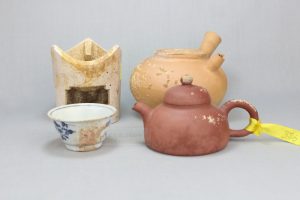
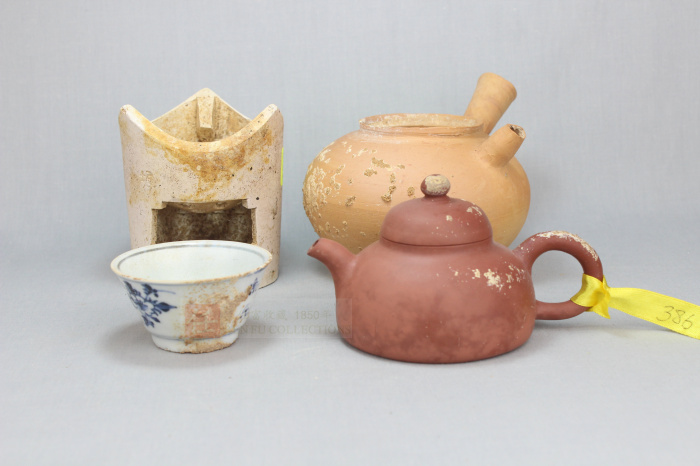
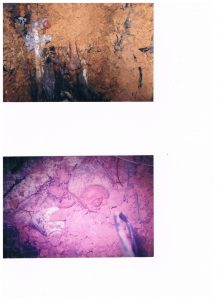
On the 28th of April1998, in the morning on the eve of the 1998 Indonesian anti-Chinese race riot, there was a rescue excavation on a site in Golden Hill (exact location classified to be only revealed for study and research purposes). After a heavy breakfast, Indonesian workers started excavations on a part of the Golden Hill which was so nicknamed because of the good FengShui and where very wealthy tombs/graves were found and mostly top grade Pots were always excavated. The first grave of the day that excavation started on was a Late Kangxi grave belonging to a woman with petite stature and inside her grave was found a Half Ball-shaped Zhuni Pot and teacup which was later recorded as Pot No:386(see picture of inside of grave and Pot No:386 and teacup).
When work started to progress to the next grave , someone noticed what looked like crumbled stones remains of an old grave with no gravestone epitaph and thereafter asked permission to excavate the grave . The permission to dig was refused at first because there were easier and faster graves to dig than this disintegrated grave which are usually disappointing in terms of results and usually took a long time to find the artefacts . Then a worker interrupted saying, “ Ini tempat ada barang bagus dan cantik!”(translated as “This place we always find good and beautiful artefacts!”) which prompted a rethink and soon permission was given to dig.(Note also that time was precious because anytime the place would be demolished for residential and commercial development and there were many other graves to rescue-excavate).
So excavation began roughly according to the 3 archaeological steps:
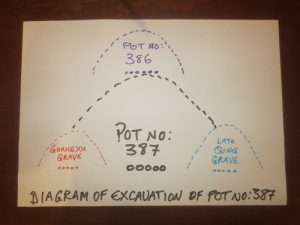
- Identification: Historical Chinese burial site. Grave without gravestone epitaph typical of Transitional Period, that is, Chongzhen/Shunzhi graves/tombs and definitely earlier than Late Kangxi( see diagram of excavation of Pot No:386 and Pot No:387).
- Evaluation: Top soil resembled Late Ming Chongzhen period grave which was deep, hard and compressed top soil (as compared to Early Qing top soil which were looser and shallower) and the bottom white desiccation layer protecting and keeping the coffin dry and free from termites and tree roots growing into the grave was typical Chonzhen(This special knowledge is only known to the very experienced digger of thousands of historical Chinese graves/tombs and the white layer could be as hard as stones and sometimes very rarely very, very hard dark stone layer like marble or granite). The Late Kangxi grave of Pot No:386 (which had a gravestone epitaph) did not encroached on or “cannibalized” the grave of Pot No:387 indicating the latter is older than the former by 30 to 50 years. Nevertheless the grave of Pot No:387 was encroached or cannibalized on the right and left side by two Late Qing graves(see diagram of the four graves). We believe and can prove that Pot No:387 is Shunzhi by the following facts:
A)There was no gravestone epitaph indicating what Nanyang historians claim was Han protest
against Manchu rule in the Transition Period( Chongzhen to Shunzhi).
B)Grave of Pot No:386 which was Late Kangxi did not encroached on or cannibalized the
grave of Pot No:387 indicating it is older than Late Kangxi.(that is Shunzhi to Chongzhen)
and also that they, the grave diggers, could see the grave of Pot No:387 when they dug the
grave of Pot No:386.
- C) No Gong Fu Tea wares like Rouchen teacups or burner or water boiler were found. Gong
Fu Tea Culture started in Early Kangxi and Zhuni Pot of this top grade or quality like Pot No:
387 usually was accompanied by Rouchen teacups and other top grade tea wares but
none was found indicating it was earlier than Early Kangxi.
- D) No Late Ming graves/tombs were found on Golden Hill.
- E) The constitution of Pot No:387 resembles a hybrid style and shape borrowed from both
Late Ming and Early Qing. The lid and handle are copied from Late Ming but the small
body and spout are a departure from Late Ming, they later became typical features of Early Qing Zhuni Pot. This Pot is the pioneering or revolutionary Pot that Hui Meng Chen created out of the Zhuni clay: a small Zhuni Hu .
Note: Tony Ren thought Hui Meng Chen was Late Ming and never thought he was Shunzhi too and therefore at one time treated Pot No:387 as an Old Meng Chen Zhuni copy. By the way, for your information during the anti-Suharto Government protests which later morphed into an anti-Chinese Race riots where the Indonesians blamed everything bad in Indonesia on the Indonesian Chinese which resulted in looting, beatings, rape and killing of Chinese in Indonesia and anything Chinese like shops, businesses and even Chinese historical burial sites were vandalized, destroyed or burnt or desecrated.
3) Mitigation or Recovery: Pictures of excavation site was taken and even the stones which were remnants of the grave were collected for future study and research. Sadly the excavation site was later bull-dozed, demolished to make way for residential development.( pictures of before and after residential development are taken for documentary purposes)
Note: How we know it took at least 120 years for a Qing grave to disintegrate or break down was by the fact that no GuangXu grave ever got encroached or “cannibalized”.
Now to the most exciting, sensational and long-awaited story of how Hui Meng Chen was discovered by a person who did not know anything about Zisha Hu and the Pot that made Hui Meng Chen very famous.
使惠孟臣成名的顺治革命家小朱泥壶是如何发现的,却又差点失传的?…………….
1998年印尼反华暴动前夕,1998年4月28日上午,在金山一处遗址进行了抢救性发掘(具体位置分类仅为学习研究之用)。吃过一顿丰盛的早餐后,印尼工人开始挖掘金山的一部分,金山因风水好而被昵称为金山,那里发现了非常富有的坟墓/坟墓,而且大部分都是出土的高档紫砂壶茶具。开掘当天的第一座墓葬是康熙晚期一位身材娇小的女子的墓葬,在她的墓葬内发现了一个半圆状的朱泥壶和茶杯,后来被记载为壶号386(见墓葬内图和壶号386和茶杯)。
当下一个墓穴的工作开始进行时,有人注意到一个没有墓碑墓志铭的旧墓穴的残片看起来像是碎石头,于是请求允许挖掘这个墓穴。一开始,挖掘的许可被拒绝了,因为有比这座崩解的坟墓更容易、更快的坟墓,而这些坟墓通常在结果上令人失望,而且通常要花很长时间才能找到文物。这时一个工人打断了他的话:“我是一个叫阿达·巴朗·巴格斯·丹·坎蒂克的人!”(翻译成“在这个地方,我们总能找到美丽的艺术品!”这引起了人们的重新思考,很快就得到了挖掘的许可(还要注意,时间是宝贵的,因为任何时候这个地方都会被拆除用于住宅和商业开发,还有许多其他的坟墓需要抢救和挖掘)。
所以挖掘大致按照3个考古步骤开始:
1) 鉴定:中国历史墓葬遗址。无墓碑墓志的墓葬是典型的过渡时期,即崇祯/顺治墓葬/墓葬,肯定早于康熙晚期(见386号壶和387号壶发掘示意图)。
2) 评价:表土酷似明末崇祯时期的墓葬,深,坚硬、压缩的表土(与清初松散、较浅的表土相比)和底部白色的干燥层,保护棺材干燥,防止白蚁和树根进入坟墓,这是典型的崇祯(这一特殊知识只有成千上万的有经验的挖掘者才知道)中国历史上的坟墓和白色的石层可以像石头一样坚硬,有时非常罕见,非常坚硬的黑色石层(如大理石或花岗岩)。康熙晚期的386号壶墓(有墓志铭)没有侵占或“蚕食”387号壶墓,表明后者比前者老了30至50年。然而,壶号387的墓穴在左右两侧被两座晚清墓穴侵占或相残(见四座墓穴示意图)。我们相信并可以通过以下事实证明387号壶是清朝顺治的:
A) 没有墓志表明南洋历史学家所说的汉族抗议反满族统治的过渡时期(崇祯至顺治)。
B) 康熙末年的386号壶墓并没有侵占或蚕食这片土地,壶号墓:387,表明它比康熙晚期更古老。(即顺治至崇祯)他们挖坟墓的时候,也能看见第387号壶的坟墓,墓穴编号:386。
C) 未发现若深茶杯、烧水锅、炉灶等工夫茶具。功夫茶文化始于康熙初年,朱泥壶的这种上品或上品如壶号:387通常伴随着红尘茶杯和其他高档茶具,但没有发现表明它早于康熙初年。
D) 金山上没有发现晚明坟墓。
E) 第387号壶的结构类似于从两者借用的混合样式和形状明末清初。盖子和把手是模仿晚明,但小壶身和壶嘴是明末的一种背离,后来成为清初朱泥壶的典型特征。这壶是惠孟臣用朱泥创作的开拓性或革命性的壶:一个小朱泥壶。
注:任汤尼认为惠孟臣是晚明,从不认为自己也是顺治人,因此一把387号壶当作惠孟臣的旧版。顺便说一句,在反苏哈托政府的抗议活动中,后来演变成了反华族骚乱,印尼人把印尼的一切坏事都归咎于印尼华人,导致印尼华人和任何类似华人的商店遭到抢劫、殴打、强奸和杀害,商业活动,甚至中国的历史墓葬遗址都遭到破坏、毁坏、焚烧或亵渎。
3) 减轻或恢复:拍摄挖掘现场的照片,甚至收集墓穴残余的石头,以备将来研究。遗憾的是,挖掘现场后来被拆除,以便为住宅开发让路(住宅开发前后的照片都是为了记录)
注:我们怎么知道一座清墓至少用了120年的时间才崩解或倒塌,是因为光绪陵从来没有被侵占或被“蚕食”过。
现在让我们来看看最激动人心、最耸人听闻、最让人期待已久的惠孟臣是如何被一个对紫砂壶和让惠孟臣成名的壶一无所知的人发现的。